Cultivating Collaboration: A Guide to Group Work
Cultivating Collaboration: A Guide to Group Work
Introduction
Learning is a fundamentally social act.
Then why does so much learning in higher education happen individually? There are many reasons for this. Often, it comes from constraints on time needed to plan, space needed to physically move around students in a class, and steadily increasing class sizes that make collaboration feel unwieldy. It also is partially a result of momentum – the way people have been taught, and have taught, often informs what they imagine to be possible, effective, or optimal. If one hasn’t experienced pedagogies that center collaborative learning or are unsure of their effects, it may be hard to take on the seemingly momentous task of experimenting with new teaching modalities, or even know what strategies best fit with your course, students, and available resources.
Taking time to experiment with your pedagogical praxis to create more opportunities for collaborative learning can meaningfully improve students’ social and academic outcomes. Socially, these opportunities cultivate meaningful in-person connections among peers, helping students feel less isolated, more supported, and more comfortable actively engaging in their learning (Børte, Nesje and Lillejord, 2023; Børte and Zeivots, 2026). Academically, pedagogical practices that foster collaboration and cooperation have been shown to: mitigate some of the pernicious aspects of peer competition on learning (Ames, 1992); support more positive and open relationships with faculty and among peers (Johnson, Johnson, and Smith, 2014); reorient learning from being motivated by extrinsic factors (e.g., grades) to intrinsic factors (e.g., learning, interest, self-improvement) (Bruffee, 1999; Prince, 2004; Mendo-Lázaro et al., 2022); and cultivate psychological safety among peers (Robinson and Held, 2025; Ratiu et al., 2026). In STEM contexts, integration of collaborative learning has been shown to be effective in bolstering communication, collaboration, creativity, and other career-relevant competencies (Leopold and Smith, 2020; Sanz-Angulo et al., 2025), increasing student self-efficacy (Micari and Pazos, 2021), encouraging class attendance and preparedness (Kelly et al., 2020), and creating a more equitable learning environment for students from underrepresented communities (Leopold and Smith, 2020; Paul and Webb, 2025; Priddie, 2024).
Different strategies of collaboration develop different skills, produce different learning outcomes, and require different forms of instructional design with varying degrees of preinstructional labor. As such, incorporating collaborative learning into your course does not necessitate a major course redesign. This guide aims to provide accessible entry points to begin incorporating collaborative learning into your pedagogical practice. It includes: micro-level strategies, ones that require little additional planning and instructional time but which bring engagement and connection into the classroom; meso-level strategies, which span one or several instructional periods, and can be adapted from an already-existing assignment, from other resources, or from scratch; and macro-level strategies, which offer a broader invitation to rethink learning and engagement in your class. While the macro-level models this guide explores are often implemented through a major course redesign, they can also be adapted for implementation in discrete assignments, classes, or units. This array of options is intended to help instructors align their interests and capacities in engaging collaborative activities with their pedagogical goals.
Understanding the Social Bases of Learning
Different fields have used different theoretical approaches to illustrate different aspects of this axiom. Vygotsky, for example, championed his psychological concept of the zone of proximal development around the idea that internal processes of learning only activate when one is interacting with those in their environment and, critically, cooperating with one’s peers (1978, p. 90). In his work on critical pedagogies, Paulo Freire takes on the issue of teaching and learning through a framework of power, collaboration, and liberation. Challenging the hegemonic banking model of education, one where knowledge flows from teacher to passive students, Freire locates liberatory education in the moments where students are transformed from pseudo-participants into committed participants in the production of knowledge (1970, p. 56). Building on this intellectual lineage, Jean Lave and Etienne Wenger pose an analytics of learning that asks us to temporarily suspend two processes that are often understood as relatively coterminous: instruction and learning (1991, p. 39). Through their work on situated learning and communities of practice, Lave and Wenger provide an alternative model for participation that is collaborative, multimodal, and fundamentally anchored in relationships. While individual cognitive work is a critical aspect of students’ learning, when students engage one another, the friction between different points of view, disciplinary backgrounds, life experiences, and technical competencies allows for deeper and more dynamic forms of understanding to arise.
Collaborative Learning, Cooperative Learning, Team-Based Learning - What’s the Difference?
While terms such as group work, teamwork, cooperative learning, and team-based learning are often used interchangeably, they are meaningfully different in their specificity, and in how interaction is structured, accountability is distributed, and learning itself is understood to occur. In most approaches to group work, collaboration functions primarily as a means of organizing labor, allowing students to divide large tasks into smaller tasks, making large assignments or final products more feasible within an academic semester. In others, namely Cooperative Learning and Team-Based Learning, interaction is not simply a vehicle for completing an assignment but a central mechanism through which learning takes place. In these approaches, moments where students interact – negotiating meaning, encountering alternative perspectives, explaining concepts to one another, or collectively constructing understanding – are the pivotal moments where learning is cultivated. This section attempts to explain some of the meaningful distinctions between strategies, provide concrete tools and suggestions for pedagogical implementation, and outline two widely used evidence-based approaches to collaborative learning – Cooperative Learning and Team-Based Learning (TBL).
Collaborative Learning
Most often referred to as “group work,” collaborative learning is an umbrella term that encompasses a wide degree of modalities of collaborative engagement. Pedagogical strategies that cultivate collaboration can range from a 5-minute turn-and-talk or a class-long jigsaw exercise to a semester-long project where students work together to produce a common deliverable. The goal of these interventions is often to increase the active role of students in the course, provide opportunities for students to challenge and grow from one another’s viewpoints, and to build essential communication and collaboration skills.
Before deciding on what strategies or modifications to make, ask yourself:
What is your objective in incorporating more collaboration in your course?
Your answer may focus on student engagement (e.g., it’s hard to get students to talk; they seem disengaged or distracted in class; students don’t seem to know or trust one another), where simple active learning strategies can be a great intervention. These micro-level activities are easy to implement, often require little additional planning or instructional time, but bring students into relation with one another in ways that can help build community, cultivate trust, and strengthen relationships among students in small seminars and large lectures alike.
Collaborative Learning Micro-activities
Students are often nervous or shy to share opinions or responses to a question aloud, especially if they haven’t been given a chance to formulate their thoughts and try them out. Especially in large classes, cold calling and reliance on verbal participation tend to favor a small number of students who are most comfortable speaking publicly and responding without preparation. In order to garner wider active participation, you could open a class with a question on a slide that begins generating ideas around the class’s major theme or learning objective. You can put a minute on your phone’s timer to allow students to jot down ideas, then ask students to discuss their thoughts with a partner near them for two minutes.
It is a good rule of thumb to bring these discussions into your lesson in order to give students a more active role in the knowledge-production process. You can do this, for example, by selecting random groups (let them know ahead of time you may ask them to share out) and asking them to share their discussion with the class, or by asking pairs to come up with a question that extends the topic, idea, or theme to a new context, introduces a paradox, or inspires a new line of inquiry, for example. These discussions can not only actively engage students, but can allow you to preview their understanding and use these data points to create adaptive entries to the class lecture or focused discussion. One way you can do this is by jotting down keywords or themes on the board (or on the slide itself if there is no whiteboard) and use these emergent themes or questions to frame the subsequent instruction. It helps to spend a few minutes ahead of time anticipating what may come up and considering how to articulate potential responses with the lesson you have planned.
Art History and Archaeology Professor Anne Higgonnet: Talk and Turn, fashion lecture
TAKE THE PLUNGE
I stopped my lecture and asked over 150 people in a room to turn to their neighbors and talk. Just talk through an issue themselves rather than have me explain it. I dreaded the decision. But I had promised Melissa Wright I would try. Would students snidely laugh? Was lecturing my job and was I therefore quitting? Dead silence. Then the room became like a beehive, humming all over. I used a timer on my phone and had to quiet the room well after time was up. As the semester went on I tried longer talk-pauses, more than one pause, pauses of different lengths, rapid-fire multiple pauses. I tied short writing exercises to the pauses. “Write down what you and your neighbors decided!” I used pauses to start practicing exam-writing skills verbally, followed by writing down the chat.
We’ve had a conversation in the past year about curiosity. To me, creating talk-pauses during lectures is related to curiosity. What does my neighbor think? And, maybe, what do I really think? Conversation, like writing, activates the brain.
Paired annotations can take many forms depending on the content and type of course. The principle of the technique is that students spend time with a text or artifact, make their thinking visible via annotation, then share with one another to compare annotations, ask questions, and gain insight into different ways to interpret or engage with the text or artifact. This could be done with annotations of one of the week’s readings, or on a case study you draft that incorporates a mechanism, an experimental protocol, or an inquiry process that demonstrates key themes, conundrums, conflicts, or paradigms you will engage in your class.
Generally, paired annotations work best with texts or artifacts that allow for multiple interpretations to generate different annotations; the similarities and differences between students working in pairs is where much of the learning occurs in this technique, so task assignment is key. You can also provide prompts for the annotations ahead of time to direct students toward the paired component. You could ask them to make note of a particularly compelling, confusing, or controversial piece of the text and annotate their thoughts around it; to analyze both the writing and argument; or make note about other texts in the course to which this one relates and how. There are many ways to implement this strategy, but the goal is to make student thinking visible to themselves and others, and to deepen their understanding through sharing, noticing, and asking.
If you’re interested in using a digital tool to support annotations, check out the Hypothes.is resources from ATLIS.
Especially in STEM courses, where some tasks have clearly verifiable outcomes (e.g., whether a piece of code runs as intended), Intentional Mistakes can create opportunities for more varied and collaborative forms of engagement. Students must not only identify errors but also explain their reasoning and propose possible solutions. If, for example, you or your Teaching Assistants notice a recurring misunderstanding or error on assessments, you could draft a chunk of code with documentation that includes this misunderstanding, or create a case study [see below] where a researcher makes a set of errors. You would then divide your class into pairs or small groups (in big lectures, pairs would be more feasible and require less planning), and then distribute these examples/cases to students and ask them to engage one another in a process of inquiry and problem-solving about the task. The key to collaborative learning in this modality is in creating robust discussion questions where students must really dialogue with one another in order to complete the task.
Your objective for incorporating more collaboration, however, may focus more on questions around student learning (e.g., students prioritize grades over understanding; you would like more depth of thinking on assessments; take-home individual assignments seem decoupled from students' understanding). If so, experimenting with a larger assignment redesign or course redesign to incorporate collaborative pedagogical practices more centrally into your course may be worthwhile. There are many different models of more involved collaborative learning, each with a different goal and a different degree of planning time needed. Below are examples of meso-level activities, which span one or a few instructional periods but which do not require a major course redesign. In addition to these strategies, our Dialogue & Difference resource also includes practical collaborative learning strategies that are particularly well-suited for pedagogical moments where disagreement, contention, or ideological conflict are anticipated.
Collaborative Learning Meso-activities
Jigsaws are a genre of activities that break students into groups, divide up a text or task into parts, then have them work in specialized groups, and finally share as representative experts in general groups. There are many iterations of structures, assessments, and ways of dividing students and tasks, but the original structure is as follows (Vives et al., 2025):
Let’s say you have a long text, or a group of highly related texts about a shared idea or concept. You assign students to distinct ‘expert’ groups, where each group reads and analyzes a specific section of the text (e.g., the introduction vs. the body, or different excerpts from a larger text). Their discussion should be driven by questions you design related to what that text is meant to do in driving learning for the class. Once they are done, they go into home groups, heterogeneous groups comprised of one team member from each of the expert groups. In the home groups, each member is in charge of teaching the group the section of text they are an ‘expert’ on, relaying the discussions, disagreements, and points of view that emerged from the expert group’s discussion. Many iterations include an individual quiz at the end to assess each student’s complete understanding of the texts discussed.
While often imagined as an activity for a single instructional period, this concept could easily be adapted to a larger activity over several instructional periods, and incorporate methods of engagement (data collection, analysis, library research) beyond textual analysis.
Case-based learning, which often overlaps with problem-based learning, is a teaching strategy that aims to have students apply their knowledge to real-world case studies that engage the key ideas, processes, questions, or queries the course addresses. Depending on the cases you create, you can place students in groups with a particular positional point of view (policy maker, parent, teacher, student, politician, organizer, doctor, patient, etc.) and ask them to break down, analyze, and problem-solve the case from the perspective of their role. You can also add other constraints (e.g., budgetary, deadlines, incomplete information) to increase ambiguity, complexity, or the diversity of priorities. There are other case study models that provide primary sources (data sets, archival documents, policy documents) and ask students to solve a particular problem using these materials. Case method teaching is a popular and established pedagogical approach in fields like medicine, STEM, business, policy, and law, as well as in broader contexts where there is a theory-practice gap (Laverty and Thompson, 2025).
The key to case-based learning lies in case design and implementation. Columbia’s CTL has a practical guide for getting started with case-based learning, which begins with ensuring your cases align to your teaching and learning objectives. Additionally, Harvard’s Kennedy School has a robust Teaching with Cases resource library with tips for planning, discussion guides, and guidance on common issues that may arise.
Writing case studies from scratch may be hard at first, so we recommend reviewing the rich case study resources available from centers and institutes across disciplinary fields in order to gain a footing in the genre of activity and for inspiration on how this method could work for your purposes:
- Columbia’s Case Consortium
(Topics: Public Policy, Public Health, Journalism, Sustainability, Spanish-Language Cases; includes full cases and accompanying teaching materials)
- Columbia SIPA’s Case Collection
(Topics: Public Policy, Sustainability, Data and Management)
- Harvard Kennedy School’s Classic Cases Library (free), larger case library (mostly for purchase) and Partners Collection of cases (free).
- MIT Sloan School of Management’s Case Study Library
(Topics: Sustainability, Accounting, Leadership and Ethics)
- Harvard Law School’s Case Studies
(Topics: legal cases on everything from corporate governance and blockchain to MOOCs and Brazil soccer riots)
- National Science Teaching Association’s Case Study Library
(Topics: Includes a wide breadth of science content, from pharmacology and evolutionary science to vaccines and medical case diagnoses)
- Center for the Integration of Research, Teaching and Learning’s Inclusive Teaching Case Studies
(These case studies involve issues around inclusive teaching, with one resource focused on issues in STEM classrooms. While intended to be used with teaching faculty, these may be useful for Education courses or department and team pedagogical training.)
When setting out to plan a groupwork assignment, keep in mind some guiding questions:
How can you leverage the higher labor capacity, broad skillsets, and different points of view of the group to create a learning experience that is more meaningful to students than an individual assignment?
How can group decision-making, brainstorming, and diverse capacities for organization, execution, and communication push learning forward?
Group work requires a higher degree of up-front planning and organization. Some things to consider as you plan:
- Task Design
In order to design a meaningful collaborative learning experience, you want to assign a group a task that (1) cannot be done individually, and (2) is meaningfully transformed through collaboration. While assigning a group the task of writing a collaborative paper may engage organizational and social dimensions of collaboration that could prove beneficial, it’s always a good idea to be cognizant of how to maximize the benefits of collaboration in a way that does not conflate group work with simply more laborious tasks.
- Making Groups
Groups can be formed for part of a class, for a unit, or for the duration of the semester. Most sources set optimal group size between 3 and 5: fewer leads to a high degree of connection and mutual accountability, but less intellectual diversity; more leads to potentially weaker social connection and less accountability, but a group with greater intellectual diversity (Burke, 2011; Shimazoe and Aldrich, 2010).
- Role Assignment
How you assign roles is key to planning group work. The selection of group roles can be quite complex and is an important deliberative step in any collaborative learning modality (Benne and Sheath, 2007). A common group-work role ensemble includes:
- Facilitator (guides discussions)
- Notetaker (records progress)
- Project Manager (manages deadlines)
- Presenter (presents information to an external audience).
Your project or disciplinary context may require modifying these roles, or adding new roles, in order to serve your students. Roles like Reflector (someone who facilitates the final decision of the group), Encourager (someone who builds and sustains productive momentum), or Evaluator (someone who challenges and questions the group process in order to ensure sound decision-making) are examples of roles that can add dimension to the group dynamics. These roles engage a variety of strengths and modalities for participation, which is key to cultivating active engagement across groups. You can ask students to rank their role preferences, or provide a skills inventory to students to help you decide on team assignments.
4.) Assessment: Participation and Understanding
How you assess group work will ideally be tied to your goals and the incentives you want to promote in your course (Meijer et. al., 2020). More traditional models assess students for their particular piece of the project, so achievement is still individualized. Other models implement a peer assessment feature alongside traditional assessment, and this allows students to hold themselves and one another accountable for their contributions to the group. Regardless of the method you choose (among the various options) to assess group work, communicating clear expectations, creating and distributing rubrics, and providing ongoing feedback is key. For examples of these tools, we suggest reviewing this self/peer evaluation form and these self/peer/group assessment templates. It is important to keep in mind, as Columbia’s CTL guide explains, peer assessment ought to focus specifically on labor, collaboration, and engagement; judging the quality and rigor of the work is the instructor’s role.
If you would like to brainstorm group project structures that are specific to your discipline and teaching context, sign up for a consultation with one of our staff!
Additional Resources:
UC Berkeley's GSI Group Work Design Guidelines
Harvard’s Bok Center Group Work resource
Yale’s Poorvu Center Group Work resource
Cornell’s Eberly Center Group Projects resource
There are many specific models of group work that are based on distinct approaches to the role of social relationships in learning. Below are two well-developed and widely used models of collaborative learning, Cooperative Learning and Team-Based Learning. While these models have distinct intellectual lineages – one in conflict resolution studies, and the other in experiential learning sciences – they both seek to create classrooms where learning is integrated into social relationships and where students are active agents in the construction, application, and revision of knowledge.
Immersive Collaboration: Two Approaches
There are many specific models of group work that are based on distinct approaches to the role of social relationships in learning. Below are two well-developed and widely used models of collaborative learning, Cooperative Learning and Team-Based Learning. While these models have distinct intellectual lineages – one in conflict resolution studies, and the other in experiential learning sciences – they both seek to create classrooms where learning is integrated into social relationships and where students are active agents in the construction, application, and revision of knowledge.
Cooperative Learning
“Extraordinary achievement comes from a cooperative group, not from the individualistic or competitive efforts of an isolated individual” (Johnson and Johnson, 1999, p. 67).
Overview
Cooperative Learning is a teaching and learning framework developed by brothers David Johnson and Roger Johnson. The foundational premise of their model is that competition negatively affects student learning outcomes, and that cooperation, when implemented correctly, meaningfully enhances student learning. Like collaborative learning, the Cooperative Learning framework consists of different group models with varying degrees of formality. Even if the strategies are the same, though, the Cooperative Learning framework is distinct in its motivational structure.
For Johnson and Johnson, students working in a group are not inherently cooperative. If students are not working towards a common goal in a context where their success or failure is entangled with one another’s, students will be more inclined to: hold back information from one another; mislead one another; or choose to not engage their peers in a mutually constructive learning process. In order to be considered a Cooperative Learning group, the structure of the assignments or assessments must construct positive interdependence among students who are working to achieve a common goal.
They identify five key aspects of Cooperative Learning:
- Positive Interdependence: The instructor must give a task and group goal so that students feel as if they will succeed or fail as a group.
- Individual and Group Accountability: The group goal, as well as individual efforts, must be measurable in order to anticipate and discourage what they call “hitch-hike” behavior.
- Promotive Interaction: In Cooperative Learning, students share resources, provide help, and offer encouragement and feedback on one another’s work and ideas. Johnson and Johnson identify the groups as providing an academic and emotional support system to facilitate the complexity of deeper learning. Students become more personally committed to their work, and motivated to achieve common goals, when they have this degree of support and responsibility.
- Instruction in interpersonal and small group skills: Students are charged with learning both content (what they call ‘taskwork’) but also the complex set of skills necessary to negotiate, lead, cooperate, and manage conflict (‘teamwork’). The related processes of cooperation and conflict mean that Cooperative Learning can help build the skills, perspectives, and confidence to engage in conflict resolution in an academic and team-oriented setting.
- Group Processing: The process of Cooperative Learning is iterative, and requires consistent reflection on what aspects of the group are working well, how they are collectively working towards their goal, and offers opportunities for students to course correct in order to meet their individual and collective goals.
Implementation
Cooperative Learning can happen in an ad-hoc way throughout a class, like through think-pair-shares periodically within a class period and focused small-group discussions at the start and close of the class period. It can also involve consistent groups that work together throughout the course of a semester or academic year. Since forming cooperative groups is labor-intensive and takes time to build trusting relationships, it’s advisable to maintain groups throughout a semester.
Johnson and Johnson indicate four pedagogical practices for instructors implementing Cooperative Learning:
- Preinstructional Decisions
- This involves everything from designing taskwork and teamwork learning objectives to deciding the size of groups, the roles and responsibilities within each group, and the way they will work together in the physical space of the classroom.
- Explain the task and positive interdependence
- It’s not enough to have learning objectives and a mental map of what success looks like; this must be communicated to students with transparent rationale, with an emphasis on the interdependence of the work.
- Monitor and Intervene
- You are monitoring whether the task is being completed, and since cooperation is itself a key aspect of the pedagogical process, you are also monitoring the effective use of cooperative skills. As you observe students working in groups, you can monitor and intervene if roles are not being properly executed or if cooperative learning is not being meaningfully engaged, providing quick and specific feedback.
- Assess learning
- It is the teacher’s responsibility to bring closure to the class, provide time for students to reflect together on the experience, and propose changes for future cooperative learning activities. This is critical so that students can engage with and name their discomfort, hesitation, or enthusiasm, and build awareness of and strategies for managing the new dynamics of cooperative learning.
Further Reading
Johnson, David W., and Roger T. Johnson. 2021. “Learning Together and Alone: The History of Our Involvement in Cooperative Learning.” In Pioneering Perspectives in Cooperative Learning. Routledge.
Millis, Barbara J., and James Rhem, eds. 2023. Cooperative Learning in Higher Education: Across the Disciplines, across the Academy. New Pedagogies and Practices for Teaching in Higher Education Series. Routledge, Taylor & Francis Group. https://doi.org/10.4324/9781003443681.
Shimazoe, Junko, and Howard Aldrich. 2010. “Group Work Can Be Gratifying: Understanding & Overcoming Resistance to Cooperative Learning.” College Teaching (Washington, United States) 58 (2): 52–57.
Team-Based Learning
Overview
“In a TBL course, acquisition of course content/knowledge is not the primary learning goal, but it is the vehicle for students to practice specific ways of thinking and acting” (Roberson and Franchini 2014: 284).
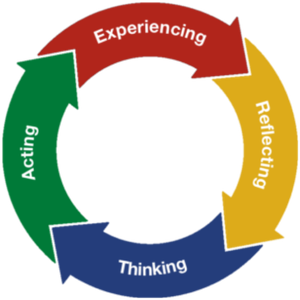
Team-Based Learning (TBL) is another model that centers collaborative student teamwork, but is based on a different learning theory principle: Experiential Learning. TBL utilizes a four-stage learning cycle, the Kolb Experiential Learning Cycle, that positions acting and experiencing as fundamental aspects of learning alongside the more commonly recognized practices of thinking and reflecting. While Reflecting and Thinking, according to TBL researchers, are processes of “grasping” information, Acting and Experiencing are actions that transform information into knowledge. The theoretical basis of this learning model is that to consolidate knowledge and integrate learning in the brain, learning experiences have to cycle through these four stages (Roberson and Franchini, 2014).
What this means for faculty looking to use TBL is that their classroom becomes a site where not only Thinking and Reflecting happen, but also Acting and Experiencing. Roberson and Franchini (2014) explain that in TBL, student learning must be made visible to themselves, one another, and the instructor in order to receive immediate and frequent feedback on their learning. To make learning visible and thus receive and give adaptive feedback, students must consistently act and apply their learning. This means that the classroom is not a place where students encounter ideas for the first time, but rather where students try out their new knowledge, apply it to curated scenarios, and negotiate concrete actions with their team members. TBL functions as a particular kind of flipped classroom, a model where students complete independent learning before class, then use the instructional time to explore, apply, and revise their learning through collaborative activities.
TBL is based on the principle that the most important kind of task we can provide students is one that involves a concrete decision. In groups, students can share their reasoning, brainstorm various implications of different decisions, challenge one another on the way their priorities, values, and assumptions shape their decision-making process, and negotiate into a collective decision. In addition to needing to make a decision under time, the questions or scenarios students grapple with must be perceived as meaningful and important to the field. Empty tasks, ones that are too easy, or that seem indulgent and unconnected to the world they’re learning about, will be met with limited interest and engagement.
Key course design aspects (Michaelsen and Sweet, 2008):
- Group Selection
Groups should remain the same the whole semester; they should be diverse in majors, skills, and identities in order to bring together the optimal breadth of viewpoints; and group members should not have a pre-established relationship (roommates, club members, friends) in order to avoid coalitions within the group.
- Pre-class Individual Study
Students are given preparation materials they must complete before the class period begins. In class, students will be asked to apply their knowledge rather than take in new information, so this is a critical part of the class design and is a significant difference from traditional courses.
- Readiness Assurance Process (RAP)
In order to incentivize students to come prepared for TBL activities, you have to conduct some readiness assessment before groups begin.
- Task Design
For TBL, designing an appropriate task that is rigorous, complex, and provokes students to apply knowledge and iteratively reflect on their learning is critical. Robertson and Franchini (2014) suggest using a backward design in which you take time to think about the kinds of decisions professionals or researchers in your field must make, then use them to plan the activity. They identify some helpful examples, like a sociologist who must decide what the implications are of a data set for explaining a particular social process, or a biologist deciding/predicting how an environmental condition impacts a given biological mechanism.
TBL uses a 4S model of task design:
- Significant Problem
Effective assignments, according to Michaelsen and Sweet (2008), must capture student interest, and if an assignment has no clear relevance to the questions driving inquiry in a discipline, students will perceive the task as busy work. The problem, case, or question should provoke an experience with the concept’s usefulness. Starting with a backward design, Michaelson and Sweet suggest identifying “something you would like students to be able to do” (p. 21), rather than know, as the outcome of the TBL process.
- Same Problem
Since students will have discussions within their groups and across the groups, everyone should be working on the same problem. This allows students to have an immersion in the thinking involved, and provide much richer and more responsive feedback to their peers’ groups.
- Specific Choice
By presenting a complex case, one that has many ways in which it can be approached and analyzed, you present a wide field of engagement. However, if students do not need to make a final choice as part of the exercise, they will often not dig deeply enough into the problems to pull out the nuances and identify the differences that make a difference. By requiring students to decide, or choose, a particular position or approach, then argue for their choice, learning often deepens and their ownership over the process increases.
Examples of Specific Choice:
- Given this focus group transcript excerpt, which analytical claim is best supported? Why?
- Given the data set pulled from OpenDataNYC, which of the following interventions is most effective? Why?
- Which of the network models best represents neural network activity? Why?
- You have two grant funding reports, one based on a theory-driven experiment and the other an exploratory big-data project on [relevant topic]. A funding agency can support only one. Which approach should receive priority funding?
- A structural failure occurs five years after construction on the project represented in the report you have. What aspect of the design would you investigate first? Why?
- Simultaneous Report
Once teams have decided on their approach and argument, they should share them in succession or simultaneously in order to dissuade changing answers or adapting new ideas into their arguments. Michaelsen and Sweet (2008) call this ‘answer drift’ and happens especially in questions where the answer is ambiguous, especially at early stages, and students are seeking consensus or cooperation. By having teams share their responses simultaneously, either whole group or in mixed small groups, holds all teams equally accountable.
If you’re interested in this strategy of teaching, you should start by exploring the broad range of materials educators have developed for TBL. While many units are available for purchase from university academic centers and curriculum developers, there are plenty of open-source materials that orient you to the method and can inspire your process of resource design.
Resources and Further Reading
Resources:
CUNY's Faculty TBL Resource: How-To Guide
Examples of 4S activities
UBC’s Guide to Writing 4S Activities
Further Reading:
Sweet, Michael, and Larry K. Michaelsen, eds. 2023. Team-Based Learning in the Social Sciences and Humanities: Group Work That Works to Generate Critical Thinking and Engagement. Routledge. https://doi.org/10.4324/9781003447528.
Wallace, Michael L., Joshua D. Walker, Anne M. Braseby, and Michael S. Sweet. 2014. “‘Now, What Happens During Class?’ Using Team-Based Learning to Optimize the Role of Expertise Within the Flipped Classroom.” Journal on Excellence in College Teaching 25 (3 & 4). https://celt.miamioh.edu/index.php/JECT/article/view/463.
References
Ames, C. (1992). Classrooms: Goals, structures, and student motivation. Journal of Educational Psychology, 84(3), 261–271. https://doi.org/10.1037/0022-0663.84.3.261
Benne, K. D., & Sheats, P. (2007). Functional Roles of Group Members. Group Facilitation, (8), 30–35.
Børte, K., Nesje, K., & Lillejord, S. (2023). Barriers to student active learning in higher education. Teaching in Higher Education, 28(3), 597–615. https://doi.org/10.1080/13562517.2020.1839746
Børte, K., & Zeivots, S. (2026). Active Learning in Higher Education: Inheriting Pasts and Emerging Futures. Active Learning in Higher Education, 27(2), 207–219. https://doi.org/10.1177/14697874261426575
Bruffee, K. A. (1999). Collaborative learning: Higher education, interdependence, and the authority of knowledge (2nd ed). John Hopkins University Press.
Burke, A. (2011). Group Work: How to Use Groups Effectively. The Journal of Effective Teaching, 11(2), 87–95.
Freire, P. (1970). Pedagogy of the oppressed. Continuum.
Johnson, D. W., & Johnson, R. T. (1999). Making Cooperative Learning Work. Theory into Practice, 38(2), 67–73.
Johnson, D. W., & Johnson, R. T. (2021). Learning Together and Alone: The History of Our Involvement in Cooperative Learning. In Pioneering Perspectives in Cooperative Learning. Routledge.
Johnson, D. W., Johnson, R. T., & Smith, K. A. (2014). Cooperative Learning: Improving University Instruction by Basing Practice on Validated Theory. Journal on Excellence in College Teaching, 25(3/4), 85–118. (98323047).
Kelly, R., McLoughlin, E., & Finlayson, O. E. (2020). Interdisciplinary group work in higher education: A student perspective. Issues in Educational Research, 30(3), 1005–1024.
Lave, J., & Wenger, E. (1991). Situated learning: Legitimate peripheral participation. Cambridge university press.
Laverty, D., & Thompson, C. (2025). Addressing the Theory-Practice Gap Using Case-Based Learning and Imagined Roles in the Graduate Communication Disorders Classroom. Teaching and Learning in Communication Sciences & Disorders, 9(1). https://doi.org/10.61403/2689-6443.1346
Leopold, H., & Smith, A. (2020). Implementing Reflective Group Work Activities in a Large Chemistry Lab to Support Collaborative Learning. Education Sciences, 10(1), 7. https://doi.org/10.3390/educsci10010007
Meijer, H., Hoekstra, R., Brouwer, J., & Strijbos, J.-W. (2020). Unfolding collaborative learning assessment literacy: A reflection on current assessment methods in higher education. Assessment & Evaluation in Higher Education, 45(8), 1222–1240. https://doi.org/10.1080/02602938.2020.1729696
Mendo-Lázaro, S., León-del-Barco, B., Polo-del-Río, M.-I., & López-Ramos, V. M. (2022). The Impact of Cooperative Learning on University Students’ Academic Goals. Frontiers in Psychology, 12, 787210. https://doi.org/10.3389/fpsyg.2021.787210
Micari, M., & Pazos, P. (2021). Beyond grades: Improving college students’ social-cognitive outcomes in STEM through a collaborative learning environment. Learning Environments Research, 24(1), 123–136. https://doi.org/10.1007/s10984-020-09325-y
Michaelsen, L. K., & Sweet, M. (2008). The essential elements of team-based learning. New Directions for Teaching and Learning, 2008(116), 7–27. https://doi.org/10.1002/tl.330
Millis, B. J., & Rhem, J. (Eds.). (2023). Cooperative learning in higher education: Across the disciplines, across the academy. Routledge, Taylor & Francis Group. https://doi.org/10.4324/9781003443681
Paul, C. A., & Webb, D. J. (2025). Examining equity and graduation rates at two institutions using a course deficit model and the collaborative learning through active sense-making in physics curriculum. Physical Review Physics Education Research, 21(1), 010107. https://doi.org/10.1103/PhysRevPhysEducRes.21.010107
Priddie, C. (2024). An Exploration of Collaborative Learning Experiences for Black STEM Students. Journal of College Student Development, 65(1), 101–106.
Prince, M. (2004). Does Active Learning Work? A Review of the Research. Journal of Engineering Education, 93(3), 223–231.
Ratiu, L., Buzea, I. M., Rus, C. L., & Otoiu, C. (2026). Beyond the surface: Unraveling the relationships between conflict, psychological safety, team learning, and performance in student teams. Studies in Higher Education, 51(6), 1338–1353. https://doi.org/10.1080/03075079.2025.2509148
Roberson, B., & Franchini, B. (2014). Effective Task Design for the TBL Classroom. Journal on Excellence in College Teaching, 24(3 & 4), 275–302.
Robinson, H., & Held, F. (2025). Psychological safety in online interdisciplinary student teams: What teachers can do to promote an effective climate for knowledge sharing, collaboration and problem-solving. Active Learning in Higher Education, 26(3), 445–462. https://doi.org/10.1177/14697874241275346
Sanz-Angulo, P., Galindo-Melero, J., De-Diego-Poncela, S., & Martín, Ó. (2025). Promoting soft skills in higher engineering education: Assessment of the impact of a teaching methodology based on flipped learning, cooperative work and gamification. Education and Information Technologies, 30(10), 13463–13506. https://doi.org/10.1007/s10639-025-13322-0
Shimazoe, J., & Aldrich, H. (2010). Group Work Can Be Gratifying: Understanding & Overcoming Resistance to Cooperative Learning. College Teaching, 58(2), 52–57.
Sweet, M., & Michaelsen, L. K. (Eds.). (2023). Team-Based Learning in the Social Sciences and Humanities: Group Work that Works to Generate Critical Thinking and Engagement. Routledge. https://doi.org/10.4324/9781003447528
Vives, E., Poletti, C., Robert, A., Butera, F., Huguet, P., ProFAN Consortium, & Régner, I. (2025). Learning With Jigsaw: A Systematic Review Gathering All the Pieces of the Puzzle More Than 40 Years Later. Review of Educational Research, 95(3), 339–384. https://doi.org/10.3102/00346543241230064
Vygotsky, L. S. (1978). Mind in society: The development of higher psychological processes. Harvard University Press.
Wallace, M. L., Walker, J. D., Braseby, A. M., & Sweet, M. S. (2014). “Now, What Happens During Class?” Using Team-Based Learning to Optimize the Role of Expertise Within the Flipped Classroom. Journal on Excellence in College Teaching, 25(3 & 4). https://celt.miamioh.edu/index.php/JECT/article/view/463