Generative AI and the College Classroom
Introduction
As of mid-2026, the rapid proliferation of generative artificial intelligence (AI) tools across all industries and digital platforms requires that each of us understand the emergent risks, potential, and basic operations. While artificial intelligence exists in many sectors, the increasing prevalence of generative AI technologies presents new challenges for educators to apply their pedagogies amidst this new landscape in ways that best serve their curricular goals and their students’ development. As such, this document will focus on generative AI over a more general conversation as it is the specific capacity to “create” that poses many of the challenges facing classrooms today.
The following recommendations are a marriage of new research by the CEP alongside previous work between the Barnard Center for Engaged Pedagogy (CEP) and Barnard Academic Technologies Learning & Innovation Services (ATLIS) to understand generative artificial intelligence and its implications in the college classroom, with recommendations for classroom activities, assessment design, academic honesty and ethical considerations regarding the potential risks of these tools. This faculty guide accompanies the CEP's Student Guide to Generative AI and complements .
Being prepared to have conversations about AI is important whether or not educators intend to utilize it themselves or allow its usage in their courses. A recent study from the USC Center for Generative AI and Society found that, without intervention, most students will use AI to “shortcut” their assignments. However, students whose professors openly discussed AI use and its potential harms and benefits were significantly more likely to use the technology thoughtfully, or not at all. This guide is intended to support these conversations, help inform positive use cases, and mediate student engagement with AI tools in ways that preserve their cognitive and emotional agency.
This technology is evolving rapidly, meaning that providing a durable or determinate overview of the landscape is near impossible; our collective understanding of what AI does and how it works is continuously changing with its exponential development. This means that nobody should feel embarrassed to feel overwhelmed or confused by these burgeoning technologies. For our part, the CEP has consulted with ATLIS and the Vagelos Computational Science Center (CSC) and continues to conduct additional research to update these recommendations.
Please email us if you have any feedback or questions about this resource. We are also happy to set up one-on-one consultations with instructors to discuss generative AI in their course and disciplinary contexts.
Recommendations for Navigating Generative AI
Understanding the Basics
In order to have open conversations about generative AI in the classroom, it is crucial to know what these tools are and how they work. While current capabilities are cutting edge, ideas of machine intelligence are not new — Jonathan Swift in his 1726 novel Gulliver’s Travels discusses “the Engine”; the creation of a chess playing machine, El Ajedrecista, presented at the Exposition Universelle in 1914; the introduction of the concept of artificial neural networks in a paper from 1943; and Alan Turing’s famous proposal of “the imitation game” and his associated explorations into whether machines can think. Today, the “Turing Test” is a method of assessing a machine’s success at communicating indistinguishably from a human. The term “artificial intelligence” was coined in 1956, with the field of study established in the same year at Dartmouth College.
Early AI worked by using pre-programmed rules known as algorithms to process data and make predictions. The same inputs always produced the same outputs, remaining within the strict boundaries of its design. With time, algorithms were able to use large amounts of data to create better outcomes, or “learn” likelihoods and trends to become more useful. This is the technology behind recommendations on streaming platforms, spam filtering, search result rankings, and GPS navigation tools. For example, more time spent watching Netflix begets better recommendations for future viewing.
Generative AI evolved from this, moving beyond the deterministic rules of traditional AI to the capability to create new content by learning patterns from existing data. This learning process, called “training,” builds a statistical model that emulates how the data is structured. When given a prompt, the model predicts the next most likely words, shapes, sounds or visuals — “generating” new text, images, video, or audio based on what it has “learned.” Unlike traditional AI, the same inputs can result in different outputs, introducing variety at the cost of unpredictability.
There are many generative AI products available, including Google Gemini, Notebook LM, and Adobe Firefly, which are all available to Barnard users (see ATLIS’ “Using GenAI at Barnard” for more details). Using pre-trained large language models, generative AI tools take text prompts from users and produce responses that are trained to mimic human writing in dialogue format and to generate images from text prompts. Notable features include its ability to answer questions, hold conversations, summarize information, and write computer code — among many other (and constantly developing) functions. For images, the models are trained on existing images, learning to associate words to pictures and to replicate various styles or structures. In all means of generation, it is important to remember that the algorithms are not genuinely creating anything new or thinking for themselves, but reorganizing existing data and original work.
Generative AI tools have a variety of limitations integral to understanding and using the tool. Discussing these with your students is important to ensuring they critically engage with the technology.
- The randomness inherent to the move from traditional to generative functions means that responses may contain incorrect information which the model may present as fact (referred to as “hallucinations”).
- As the models are trained on existing data, datasets that are not representative will produce outputs that reflect these biases. For example, overrepresentation of white men in C-suite positions (a result of structural sexism and racism) will register whiteness and maleness as determinative qualities for leadership potential. This means that although algorithms do not hold the same prejudices as humans, their outputs still often incorporate them. Consequently, researchers need to be very mindful about their data collection and what social biases could be unknowingly imported with it.
- Large language models (LLMs) may not grasp the context of the prompt, struggling with “common sense,” idioms, and sarcasm. Although they are trained to respond conversationally, an algorithm is only as strong as its training data; they are not human and do not have knowledge or understanding of the material they generate (as much as headlines may make it seem otherwise).
- Some generative AI tools such as Notebook LM are designed to pull from defined sources, making it easier to see where outputs were drawn from. Other tools may rely on broad training data or retrieve information from across the web, and their sources and reasoning may be more opaque unless citations are provided.
Generative AI and Learning
As these are new and evolving technologies, studies are only just emerging to assess the impact of generative AI on learning. So far, the results are mixed, with some studies demonstrating improved learning outcomes for students using generative AI tools (particularly in maths and sciences), although these gains appear to be temporary (Bastani, 2025).
A key concern remains how generative AI can reduce the cognitive load taken on by students, reducing the friction required to write, research, analyze – critical skills that are key to learning. A study from Cornell found that students who wrote using generative AI tools showed less brain activity, students’ writing became increasingly homogenous, and the students were less capable of recalling their own work. Researchers from MIT found that this short-term convenience may decrease individual function, not only in academics, but across neural, linguistic, and behavioral levels. Consequently, it is important that generative AI is treated as a tool, not a mental surrogate. Researchers are developing ways generative AI can be used to improve learning through limited applications that encourage students to receive feedback, perform active practice, and reflect on their learning.
Some research has suggested these technologies could help students with disabilities, creating more accessible pathways to learning. A study out of Oxford University highlights the lack of empirical studies required to provide conclusive evidence or best practices, highlighting the need for further research and development to build meaningful interventions for disabled students. Informal studies have identified opportunities for personalized learning, facilitating critical thinking and as this article discusses, some instructors have found that generative AI tools can help reduce the anxiety of planning a first draft, leaving more space for critical and creative thinking. The Stanford Accelerator for Learning has explored recommendations for developing AI while centering needs of people with disabilities, prioritizing empathy and access. However, as this report from the World Economic Forum explores, these benefits require regulation and oversight to be fully realized and mitigate the risks.
In short, experts are unsure of what the impacts of generative AI are or will be as the technologies evolve and studies continue, but the CEP is monitoring developments in research and learning outcomes, ensuring any pedagogical recommendations for engagement are evidence-based and meaningful. In any case, it is crucial that professors engage with the thorny ethical complications that these technologies introduce.
Further reading:
A Systematic Review of Generative AI for Teaching and Learning Practice
Research on the application of artificial intelligence in personalized learning of college English
What Restorative Justice Teaches Us in an Age of Artificial Intelligence
Trained AI models exhibit learned disability bias
Why AI fairness conversations must include disabled people
Designing Generative AI to Work for People with Disabilities
How ChatGPT could help or hurt students with disabilities
Generative AI and Teaching
We know that many students are using generative AI, regardless of stated course policies. A 2025 survey of Harvard undergraduates found that 85% use AI at least biweekly, over 50% rely on it for writing assignments, and national data offers even higher numbers (Hirabayashi, 2025). At Barnard, we have found a mixture of usage patterns ranging from reliance to refusal, so having conversations with your students about their experience, expectations, and concerns is an important component of building expectations and course approaches.
AI in the Classroom
Professors across the Barnard community are contending with how and if they will integrate generative AI into their courses, as well as how to address student usage. Regardless, having open (and not necessarily technical) conversations is proven to help students use these tools with deeper consideration. This comprehensive resource on Teaching and Learning with Generative AI from Stanford offers a range of topics that instructors and students can consider as ways to frame these conversations. The widespread use of generative AI offers many subject-specific conversational interventions across all fields.
For example:
- How AI interacts with existing power structures, requiring consideration of how AI can serve as an extension to colonialism and power
- The impact of data centers use on existing water shortages and attempts to reduce reliance on fossil fuels.
- The use of AI to support medical professionals and researchers to accelerate the development of new drugs, perform genomic analysis, find abnormalities in scans for faster diagnosis, and other applications. How does what we know about AI bias impact these practices?
- The role of technical expertise in government, and questions regarding effective regulatory structures.
- The copyright implications of generated images and text, the value of process
- Questions of surveillance, algorithmic analysis of applications and personal work, and the right to be forgotten.
- Impacts on mental health, sociability, shared truths and cohesion.
- Among many others. Reach out to the CEP if you would like a thought partner in how AI could fit into the existing material in your class, not only as a tool but as a point of discussion.
Consider reviewing existing assignments to place greater emphasis on the learning process, not only the final product. This may involve scaffolding assignments through steps such as proposals, drafts, smaller interim tasks, revisions, and reflections. Making these stages visible can help students engage more deliberately with their learning and provide opportunities to demonstrate how their thinking develops over time. When possible, remain open to student input on process-based assignments, since students’ approach to process may differ. For a consideration of process tracking and its complexities in the age of AI, see this blog post on neurodivergence and alternative grading by Sarah Silverman and Emily Pitts Donahoe.
As researchers do not yet know what the exact benefits or risks are of AI in the classroom, educators are collectively working on pedagogical strategies in this technological landscape. If you choose to incorporate generative AI in your course, consider foregrounding your permission to use generative AI in a conversation about citational practices and the ethics of transparency in research methods. Given that these tools are relatively new and conventions are still forming, this is an opportunity to think collaboratively, critically, and creatively with your students on what scholarship and research will mean in the context of generative AI, and what protocols might already be in place within your field or discipline. For assignments that encourage or require the use of AI, ensure the work can be done with tools for which Barnard has institutional licenses, ensuring that all students can afford to use these products without being disadvantaged compared to students with access to paid versions.
You may also choose to make your courses low tech/no tech classrooms, which some professors have found successful in promoting student attention (Muhlen, 2025). This is an extension of conversations from before the advent of AI in education, as educators weigh the benefits of technology against their impact on discussion quality, participation in class or small group collaborations, and cognitive engagement. These courses of action require liaising with the office of disability services regarding potential accommodations students might have in place and other means of supporting them.
Reasons for a low tech/no tech policy include:
- Laptops can create distractions, both for the student user fighting the impulse to veer away from classwork and the neighboring students. This impacts learning for both parties and aggregates to impact long-term retention.
- Devices can unintentionally impede student participation in group discussions, either due to student distraction, or other students being less willing to participate while their peers are distracted (Hall, 2020).
- Unmediated AI use can undermine teaching goals, violate privacy agreements, and complicate the enforcement of plagiarism policies (Kotsis, 2024).
- Studies show that handwriting encourages students to put concepts in their own words and encourages greater brain activity, improving retention and understanding. A study from 2022 compiled 33 previous studies and found that handwriting stimulates more elaborate and widespread brain activity, leading to handwriters scoring considerably higher on average on tests than those who type their notes (Lau, 2022).
These policies require reflection on why you are implementing this policy, and open communication with your students.
- Be clear about what technology is or isn’t allowed, and when. For example, you might allow laptops for note-taking but not during discussions. This should be clearly communicated in your syllabus and in class.
- Include your reasoning, perhaps sharing research regarding distractions or facilitating a conversation about student experiences with technology in class.
- Invite students to discuss their concerns about the policy with you, or consider gathering feedback from students about what did and did not work for them.
- If note-taking is to be done by hand, students may express concerns. These may be mitigated by allowing extra time for those to catch up, sharing course slides or key terms highlighting the most important concepts, or sharing strategies for good note-taking.
These strategies are not a panacea, as distractions or poor class performance can stem from other causes. It is also important to consider the potentially diverse motivations for using generative AI software and other technologies, and how course design could influence them. For example, do they arise from stress about the writing and research process? Time management on big projects? Competition with other students? Experimentation and curiosity about AI? Grade and/or other pressures and/or burnout? Confusion regarding the material? As stated in this article about ChatGPT-generated abstracts fooling scientists, solutions to the use of generative AI will likely be found by critically examining the pressures motivating students and scholars to use it rather than by focusing solely on preventing and detecting AI-generated work.
Assignments
Knowing that these tools exist requires educators to rethink their approach to teaching and evaluating students’ learning. If AI is taking over the cognitive load of classwork and assignments, these assessments fail to evaluate the student’s own capacity. Where it was previously more obvious, the evolution of generative AI is such that LLMs can produce passable writing, code, and solutions to problem sets. Software designed to detect prohibited AI use has also proven too unreliable to be a meaningful tool.Instead, educators have to look at the structure and requirements of courses and develop more reliable means of learning, practice, and assessment.
The types of assignments that are most susceptible to AI completion without detection are take-home short response papers and essays, take-home problem sets, and take-home exams. These risks can be mitigated by pairing them with requirements for students to show their work, demonstrate their process, presentations, or answering reflection questions in person. For writing projects, “scaffolding” assignments by breaking it into steps (topic proposals, outlines, drafts) and offering space for revision, growth, and feedback from peers, TAs, and/or the instructor reduces the grading load of each individual step. This kind of structure allows educators to get a window into the development of students’ thoughts and understanding, and may make students less likely to rely on tools in completing their assignments.
Whatever your choice on AI inclusion, it is most important to consider your educational goals. Courses may embrace AI, in which case they should be clear about the risks, benefits, and global context it operates in. Deciding your level of engagement should include thinking about where the course sits in the larger degree or program context; are students building disciplinary foundations and demonstrating essential skills or is it a more advanced class where AI could be used as part of the process to develop literacy and support task management? What can we do to demystify these technologies without sacrificing students’ subject literacy, academic capacity, or personal development.
The types of assignments that are less susceptible to AI use are oral exams, oral presentations, video essays, posters, “visual abstracts” of scientific papers, in-person blue book exams, and on-paper annotation of problem sets. Research from Cornell suggests that assessments with interconnected problems, with each problem building on the last, and assignments that are semi-determined are more resilient against AI than those with fixed and predefined terms of correctness. Entirely open-ended questions lack boundaries, allowing AI to reduce accuracy, invite fabrications, and potentially successfully mimic a student voice making it harder to identify.
While it is understandable, and may in many cases be desirable to turn to hand-written assignments to evade AI submissions, it is important to keep accessibility in mind; hand-written work, especially on timed exams, can be difficult for students with disabilities and students who use screen readers. For a recent consideration of the issue of timed exams in light of AI, see “AI text generation: Should we get students back in exam halls?”
Asking students to relate details from a reading, lecture, experiment, or class discussion to their personal lives or offer personal reflections can engage students in the material and help them see its relevance. However, bear in mind that such writing can still be simulated as some generative AI tools are adept at simulating reflective writing or writing that appears to draw upon personal experience, if given enough personal information about a student.
For a compendium of assignment and activity ideas, see the professor-led site, Against AI.
Prioritize reflection and growth in the learning process. This might take the form of supplemental process reflections, requiring a writer’s memo to accompany a final paper or project, or a response to a metacognitive prompt after any assessment or activity. Make sure that students are aware of the various available resources on campus, from office hours to resources such as Tackling Large Assignments with students to provide guidance around how to manage time and successfully plan for final course assignments.
For exams and quizzes, consider offering partial credit if students show their work or supplemental reflection questions where students can explain how and where they got stuck on a question or problem and why. When possible, give students opportunities to revise and learn from errors. In general, focusing on process over product creates more opportunities for success, which has been found to deepen students’ intrinsic motivation and deter them from academic dishonesty.
If you choose to incorporate generative AI into your course assignments, state explicitly how you would like students to cite their use of generative AI technology within their assignments or assessments or ask them to cite these products based on the citational system common within your discipline. The Modern Language Association (MLA) has published explicit guidance on citing generative AI,as has the American Psychological Association (APA). It is important to explicitly articulate your requested citation format or style in writing so students understand what is expected of them.
Find additional support in further CEP resources such as our Active Learning Guide, Creating an Engaging and Inclusive Classroom and Flipped Classrooms
Further Reading:
Digital Resilience in Higher Eduction
Written Assignments and the Ethical Considerations of Artificial Intelligence in Higher Education
Use of Portfolios to add Generative AI Resilience to Chemistry Final Year Literature Projects
Integrating artificial intelligence in STEM education
The Landscape of AI in Science Education: What is Changing and How to Response
AI Can Answer Questions — But only we can teach why they matter
AI-Resistant Assignments in Writing Class
Designing an AI-Resilient Assessment Framework in Open and Distance Learning
Explore faculty-facing resources on generative AI
The following resources on generative AI in the college context may be helpful for learning about the technology and its implications for academic integrity, assignment design, student engagement, and the future of AI:
- “Teaching and Learning in the Age of AI” developed by the Columbia Center for Teaching and Learning.
- “Discipline-specific Generative AI Teaching and Learning Resources” developed by University of Delaware Center for Teaching & Assessment of Learning.
- “Teach with Generative AI” from Harvard University has plenty of useful resources including the “Harvard GenAI Library for Teaching and Learning,” the System Prompt Library offering a range of effective prompts that can be used by educators, and Examples and Ideas for Using AI for Your Teaching out of Harvard’s Bok Center for Teaching & Learning.
- “Artificial Intelligence Teaching Guide” produced by Stanford, featuring various workshop kits expanding on topics regarding understanding the technology and its potential in teaching and learning.
- MIT has several helpful guides such as “Navigating Data Privacy” and “AI Detectors Don’t Work. Here’s What to Do Instead.”
Experimenting with Generative AI
Familiarity with generative AI tools, regardless of whether you intend to use them, can be helpful to planning how and if these tools are relevant and appropriate in your classes.
Ask yourself:
- What prior experience with generative AI do I have and how has this contributed to my perspective on it?
- What have my prior experiences with generative AI taught me, particularly in relation to education and pedagogy?
- Are my learning goals for the class compatible with AI use? If not, why not? If they are, how are they compatible?
- What are other people in my discipline doing in response to AI? What questions do I have about whether and how to integrate generative AI into my courses?
These are also questions to discuss with your students to cultivate open communication about their thoughts, experience, and preferences regarding integration of these technologies into course themes and practices.
These are issues that teachers around the world are facing; explore AI platforms and practices relevant to your discipline, assessing how the various functionalities could enhance your practices.
Refer to discipline-specific Generative AI teaching and learning resources as well as this report from Cornell on Generative AI for Education and Pedagogy, outlining its possible use in writing, performing arts, social science, STEM, and computer science courses.
Further reading for continued reflection:
- Stanford has a selection of curated curricula on topics ranging from algorithms in everyday life to using and analyzing sentiment analysis to using generative AI models creatively to generate text-based or image-based ideas for artwork
- Mollick and Mollick’s “Assigning AI: Seven Approaches for Students, with Prompts” (2023) offers several detailed prompts for different purposes (AI as mentor, tutor, coach, teammate), including example conversations with ChatGPT-4
- This report published in Science Magazine on managing bias as part of AI and the transformation of social science research
- Timnit Gebru, formerly of Google, is an important voice in AI ethics. Read about the importance of centering humanity within AI development, a personal reflection on who tech is for, explore some of her research,
- MIT Technology Review speaks with teachers optimistic about the potential of generative AI for learning
- Writing instructors may find the resource AI Text Generators and Teaching Writing: Starting Points for Inquiry
Critically discuss and reflect on ethical considerations around generative AI with your students
In addition to the implications of generative AI in your classrooms, this technology remains a looming concern for students in their lives beyond graduation. When using generative AI, the costs may be hidden from the individual, but they still very much exist. Making these considerations visible can help encourage students to be thoughtful and critical regarding their usage. It can be easy to feel hopeless and assume that all students are secretly — or not so secretly — relying on these tools, but survey data reflects a more nuanced picture of usage.
“Sometimes it feels like everyone else uses AI, so not using AI puts you at a disadvantage, no matter how much I do not want to.”
“[I use AI] for learning when it’s GENUINELY impossible for anyone to follow along with the teacher, it is my last resort to receive feedback and be able to learn concepts that I was supposed to be taught.”
“When I am writing, I get overwhelmed and develop writer’s block easily because I get confused if my writing is making sense… Asking if my outline/paragraphs flow & make sense without changing the wording helps me keep track of my flow of logic when writing.”
“After using AI heavily in a math course last semester, I now limit myself in how I use it… I find this helps me learn a lot better than just having the AI do stuff for me.”
“I am putting a massive amount of time and resources into getting a world-class education— I think it is patently ridiculous to waste that opportunity by letting a robot think for me.”
“I am afraid I will lose my ability to think critically and write and give it over to ChatGPT, therefore disallowing me from thinking for myself.”
All of us, students, faculty and staff alike are facing these issues every day. Discussing your position and expectations, as well as your thinking behind them, may open the door for students to share their own thoughts. Our shared informational waters have never been muddier, so it’s particularly important to have open conversations and help students to move carefully and critically, regardless of what tools they choose to use.
Making Decisions About Generative AI
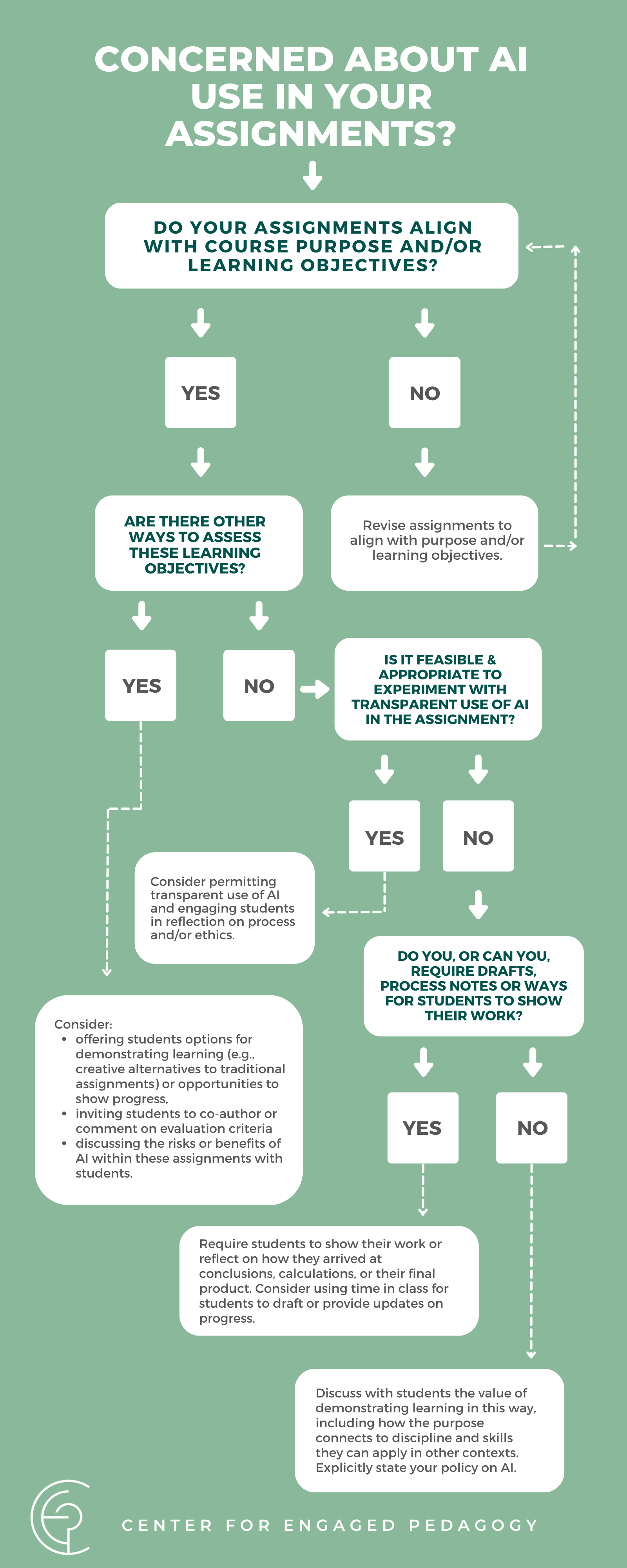
These two resources can be used to guide your decision on whether or not you will incorporate generative AI in your classroom. Access a larger version of these infographics on the CEP Website. View and download a pdf version. Download as a simple text PDF.