When Barnard set out to transform and modernize its science facilities, women led the project at every level — from its conception to its design, construction, and beyond.
The Roy and Diana Vagelos Science Center (RDSC) represents something much larger than a new campus building. It reflects generations of women who fought for and expanded opportunities in STEM, and the students who will carry that legacy forward.
The RDSC is New York City’s first net-zero carbon, all-electric academic science building. By bringing more of the sciences under one roof, it will centralize campus research and open dynamic new learning opportunities for students and faculty across the College.
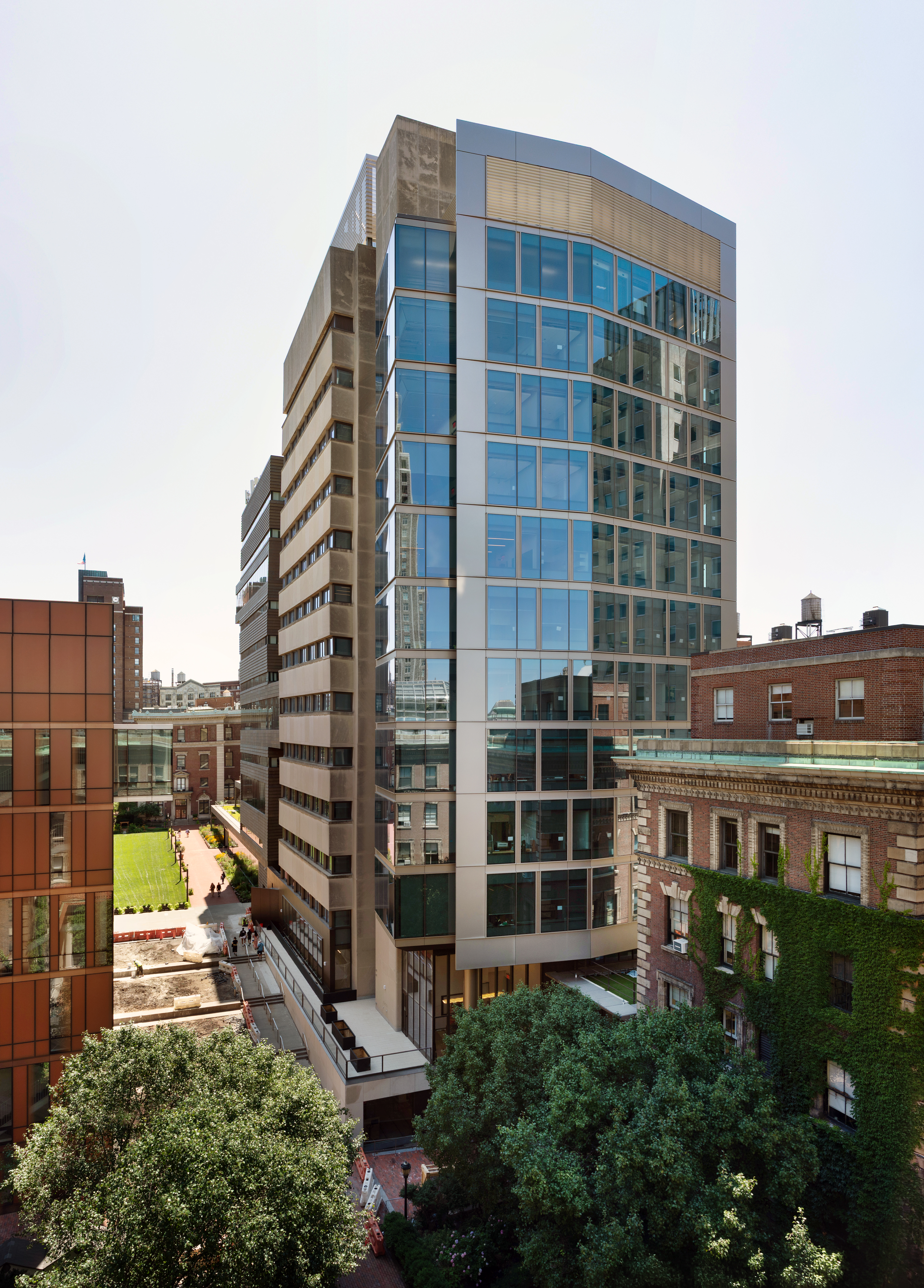
“Science is an essential part of a rigorous liberal arts education, and the RDSC gives our students and faculty state-of-the-art spaces to ask questions, conduct research, and make discoveries together,” said President Laura Ann Rosenbury. “As New York City’s first net-zero carbon, all-electric academic science building, it also reflects the ambition we have for Barnard’s future. We are grateful to Roy and Diana Vagelos, whose extraordinary generosity made this building possible and will benefit generations of Barnard students.”
“The RDSC will touch every student at Barnard, centralizing the bench sciences and also welcoming students from majors across the College to acquire a true breadth of liberal arts knowledge,” said Rebecca L. Walkowitz, provost and dean of the faculty. “We have structured Barnard’s curriculum to encourage engagement across the natural sciences, social sciences, humanities, and arts, and our students have responded to that by combining methodologies and research questions drawn from both STEM and non-STEM disciplines, whether neuroscience and dance, psychology and human rights, or biology and public policy.”
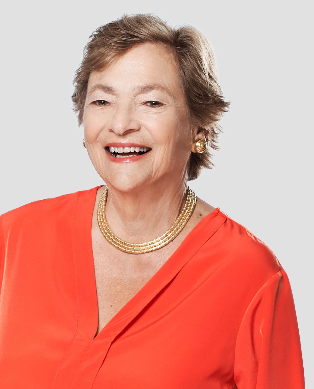
The building was made possible by a $55 million gift from Diana T. Vagelos ’55, vice chair of the Board of Trustees, and her husband, Dr. P. Roy Vagelos — the largest donation in Barnard’s history. The RDSC marks the latest milestone in the Vagelos family’s decades-long commitment to advancing women’s education at Barnard. Their contributions have shaped every corner of campus and every facet of academic life, from the Diana Center and the Vagelos Computational Science Center to the Diana T. and P. Roy Vagelos Professorship of Chemistry.
Additional support came from Daphne Recanati Kaplan and Thomas S. Kaplan P’24; Trustee Lida Orzeck ’68; Cheryl Glicker Milstein ’82, former chair of the Board of Trustees, and Philip Milstein P’14; and Gail Alexander Binderman ’62, through the Norman E. Alexander Family G Foundation.
The Woman Behind the Vision
When the Vageloses visited the construction site in the fall of 2025, Diana spoke to the impact the RDSC would have on generations to come.
“When I first stepped onto Barnard’s campus 75 years ago, I saw a place of limitless opportunity that helped shape my life and define my path,” she said. “I take great pride in knowing that this building and the educators who utilize it will help pave the way for the next generation of women leaders who will change the world, one discovery at a time.”
Science education at Barnard has grown significantly since the 1950s. When Diana first arrived, the College offered a limited range of science subjects: astronomy, botany, chemistry, geology, mathematics, physics, psychology, and zoology. Seventy-five years later, Barnard’s STEM offerings have expanded well beyond that list, balancing the traditional bench sciences with newer disciplines like computer science, environmental science, and neuroscience — fields added to reflect interdisciplinary research, student interest, and new challenges in the world.
Over the past decade, the share of Barnard students majoring in STEM has grown from 35% in 2016 to 48% today. In the 2025-2026 academic year, Barnard’s STEM departments and programs offered more than 180 courses. That growing demand was the catalyst for the transformation of Altschul Hall into the RDSC. The project was first announced in 2022 under then-President Sian Leah Beilock, and Barnard broke ground in 2024.
The new facility builds upon Altschul’s footprint. The memories of the women who walked its halls in pursuit of scientific discovery will remain in the RDSC as new generations and evolving research fill the spaces.
The Women Who Built It
Kelli Murray, executive vice president for strategy and chief administrative officer, said the building was designed specifically with women in mind.
“Every detail of the RDSC was intentionally inclusive,” said Murray. “Every design element, down to the laboratory furniture, was carefully examined through the lens of a women’s college, with the knowledge that the space would be used primarily by women.”
Design, project, and construction management were led by a female-forward architectural and engineering team — a rarity in a historically male-dominated industry, and one recognized by the 2026 Built by Women Initiative. The associate principal architect, the project manager on the construction team, and the director of the relocation management company are all women.
“We are especially proud that the RDSC was built by women in the sciences to help encourage scientific discovery, whether it’s in the setting of a classroom or a lab,” Murray said. “And because Barnard College is a women’s college that is primarily run by women, it’s no surprise that when it came time to design this academic science building, the team that came into place was female-forward.”
Emily Grandstaff-Rice, senior project manager and associate principal architect at Perkins&Will, noted that designing for a women’s college required distinct intentionality. That meant adjustable workstations, inclusive laboratory furniture, and baby-changing stations on every floor. She also emphasized the technical hurdles of renovating a building rather than building from the ground up.
“It’s a different game,” she said. “But it’s also an opportunity to go back to the sustainability story. Any time you can save a building, or save the structure of a building, that’s material you’re diverting from a landfill.”
Faculty helped shape the building from the start. Dina C. Merrer, professor of chemistry and dean of science, guided the design process from its inception, working closely with the STEM faculty whose departments would be housed in the RDSC.

“Barnard scientists participated in the design of every corner of the RDSC, from its laboratories, classrooms, and meeting spaces to the critical systems concealed behind walls, above ceilings, and below floors,” said Merrer. “Faculty and staff representatives from each of the five RDSC departments have met weekly with the construction team for the past four years to ensure smooth progress of the project.”
The RDSC will house the biology, chemistry, environmental science, neuroscience and behavior, and physics and astronomy departments. Unifying the College’s bench sciences under one roof will eliminate barriers between disciplines, foster collaboration, and expand Barnard’s research capacity.
“Experiential learning in teaching and research laboratories is at the heart of being a scientist. The accomplishments of Barnard science graduates as professional scientists, engineers, and health professionals directly correlate to their undergraduate laboratory experiences,” said Merrer. “The RDSC will provide the venue for these formative experiences for generations to come.”
A Model of Sustainability
The RDSC was designed to meet LEED Gold standards, with measures addressing energy efficiency, water conservation, responsible materials, and the creation of a healthy, high-performing indoor environment for students and faculty.
Keeping the existing structure rather than demolishing and replacing it allowed the project to avoid 52% of the additional carbon emissions new construction materials would have generated. Reusing existing materials cut construction waste by 56%, diverting it from landfills to be sorted and recycled. Water conservation strategies will reduce indoor water use by 28%.
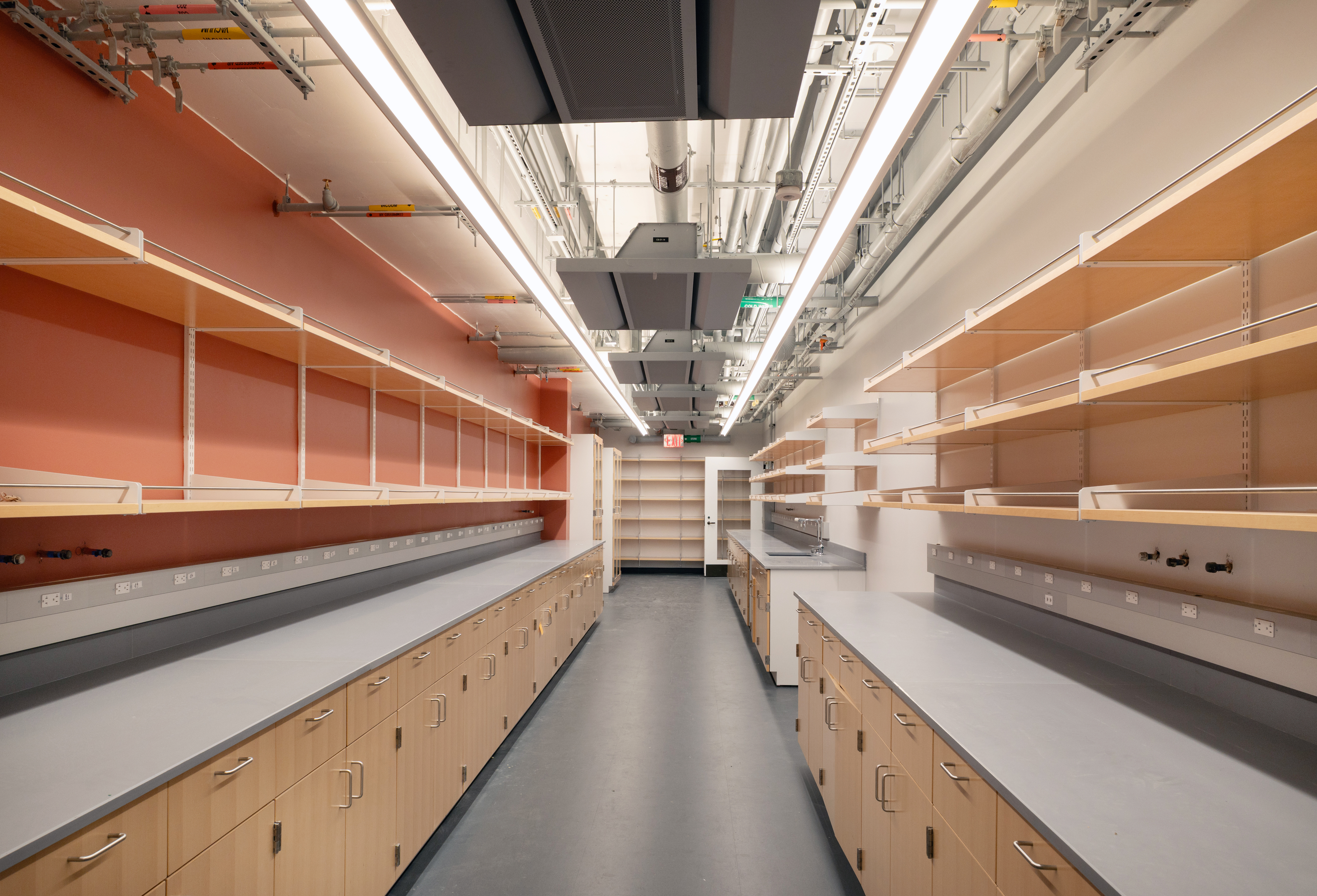
The renovation also eliminated on-site fossil fuel use, fully replacing Altschul’s gas- and oil-fueled steam boiler plants with an all-electric HVAC system that uses heat pumps for heating and chilled water. A building management system adjusts settings based on real-time occupancy and conditions, and glass-backed fume hoods bring natural light into the teaching labs, reducing the need for electric lighting.
Global engineering and advisory firm TYLin directed the project’s sustainable structural transformation. Designed around “biophilia” — the human instinct to connect with nature — the RDSC incorporates interior glass walls and expansive windows offering clear outdoor views. Those walking its halls will notice color schemes drawn from Riverside Park and bird-friendly window frit.
The RDSC is the latest milestone in Barnard’s pledge to reach net-zero emissions by 2040, a commitment that spans academic buildings and residence halls alike. Sustainability is also being built into the curriculum: beginning in fall 2028, all incoming students will be required to take a course under a new Mode of Thinking, “Thinking Ecologically and Sustainably.” Many students already enroll in these courses; the new requirement formalizes the subject as a core part of a Barnard education.
The Community It Will Serve
For students like Jenelle Smith ’28, a double major in biochemistry and medical anthropology, the RDSC will become the focal point of her academic life.
“I think it’ll quickly become one of the places I spend the most time on campus,” Smith said. “I am especially excited for the updated lecture halls, modern lab spaces, and more areas designed specifically for students to collaborate and study.”
To Smith, the building reflects the College’s commitment to giving students both the resources to study STEM and the breadth of a liberal arts education.
“One of my favorite parts about studying science at Barnard is that I’ve been encouraged to think beyond the lab. My major requirements for biochemistry have given me a strong science foundation, while medical anthropology has taught me to think about health through cultural and social perspectives,” Smith said. “I think the liberal arts approach prepares me to become not only a better scientist, but also someone who can connect research to real people and real-world challenges.”
That breadth is by design. Barnard’s general education curriculum requires every student to take two approved science courses — one with a lab, and a second as either a lecture or a lecture-plus-lab.
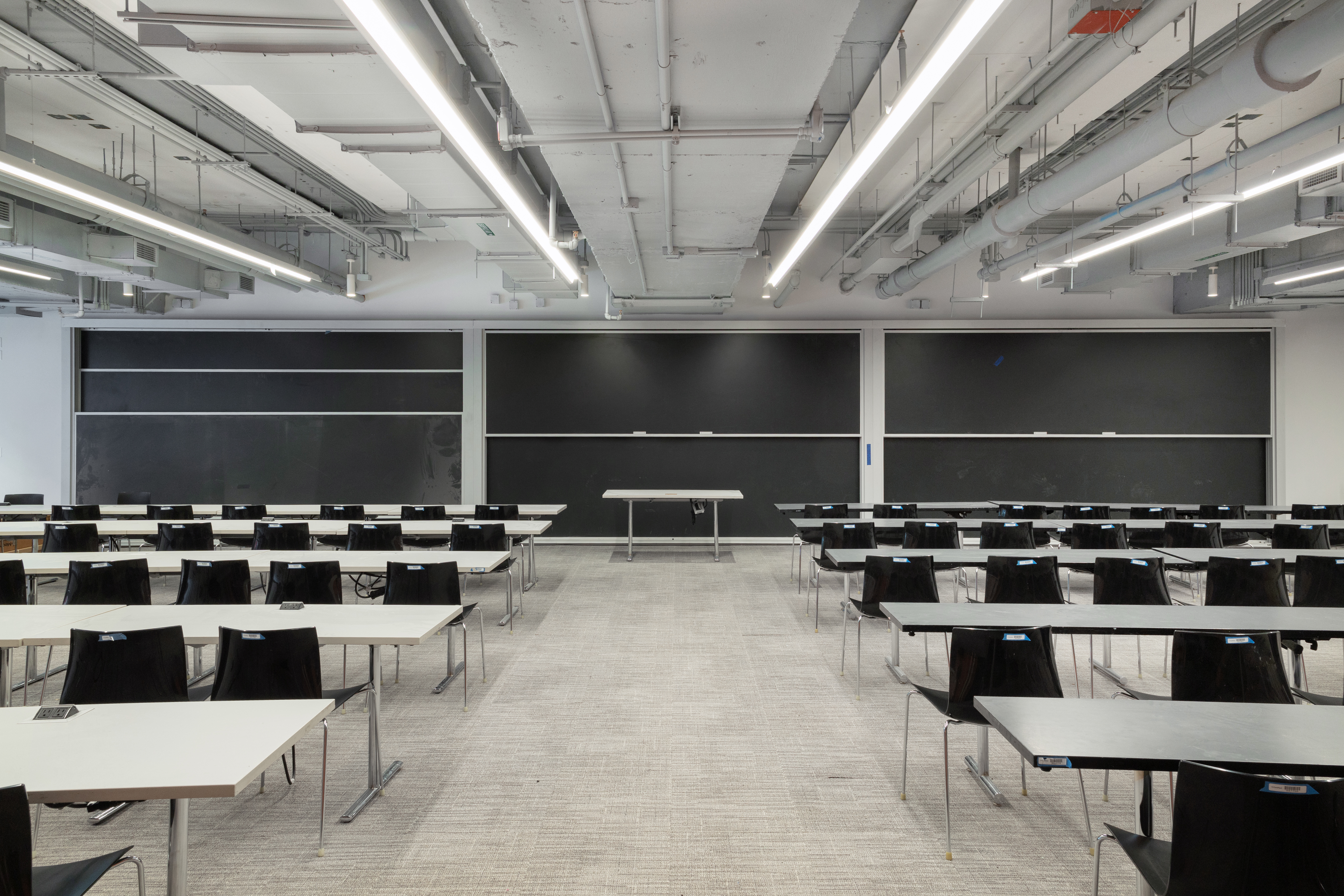
The RDSC also expands the capacity for faculty-led research. Reshmi Mukherjee, the Helen Goodhart Altschul Professor of Physics and Astronomy, will have on-campus lab space for the first time in her career.
“I am hoping that I can build a state-of-the-art gamma-ray instrumentation research lab,” Mukherjee said. “My research focuses on developing next-generation gamma-ray instruments. Recently, NASA approved one of our collaborative projects for a Physics of the Cosmos balloon mission.”
BJ Casey, the Christina L. Williams Professor of Neuroscience, said the new labs will change what her students are able to do.
“Lab spaces have been limited,” said Casey. “The [RDSC] is going to give my students much more of a hands-on appreciation of the research as opposed to simply analyzing open-access data.”
Casey noted that neuroscience does not function in isolation, and that understanding the brain within society requires grounding in other sciences and the humanities. Students from across majors coming into the building will encourage that kind of thinking.
“There will be a cross-fertilization of faculties, interests, and questions among students,” said Casey. “I think it’s a statement to the world that Barnard is a hub or a beacon for women scientists.”
The College supports that work in other ways as well. For the last 12 years, the Summer Research Institute (SRI) has provided funding and housing for students conducting ten weeks of paid summer research under faculty guidance, culminating in the Lida Orzeck ’68 Poster Session. Research spans fields including biology, chemistry, neuroscience and behavior, physics and astronomy. This past summer, SRI supported nearly 300 students.
That commitment builds on a long history of Barnard scientists, among them Dr. Alison Estabrook ’74, chief of the Comprehensive Breast Center at Mount Sinai-Roosevelt Hospital in New York, and Jacqueline Barton ’74, a pioneering chemist and recipient of the National Medal of Science.
The College fosters early interest through pre-college programs like the STEMinist track, which gives high schoolers hands-on experience in fields ranging from neuroscience to public health. Roughly 450 high school students participated in pre-college programs this past year.
When alumna Judith Joseph ’56 returned to Morningside Heights for her seventieth Reunion earlier this year, she toured the RDSC and reflected on her own time as a STEM student.
“We had 15 chemistry majors in my year,” Joseph said. “It’s really wonderful that there are so many women involved in the science programs at this point. The [RDSC] makes it very exciting for people to come and study here, knowing that it’s very up-to-date and competitive.”
Long after the doors open and the laboratory benches fill, the building’s greatest achievement may be the work of the women whose ideas take shape inside it.
Diana Vagelos, addressing the Class of 2026 at Barnard’s 134th Commencement in May, left the graduates with advice that speaks to the RDSC’s core mission.
“Stay curious but also stay connected,” she said after receiving the Medal of Distinction, the College’s highest honor. “By remaining curious, I mean be open to new ideas and new experiences. Be flexible. Be willing to change your mind. Barnard has helped shape who you are and who you will be. So keep that in mind. And don’t forget Barnard.”
Pictured above: Diana T. Vagelos ’55 and Dr. P. Roy Vagelos cut the ribbon at the opening ceremony of the RDSC.
Published in the Summer 2026 issue of Barnard Magazine with the headline "The Women Who Shaped the Roy and Diana Vagelos Science Center."