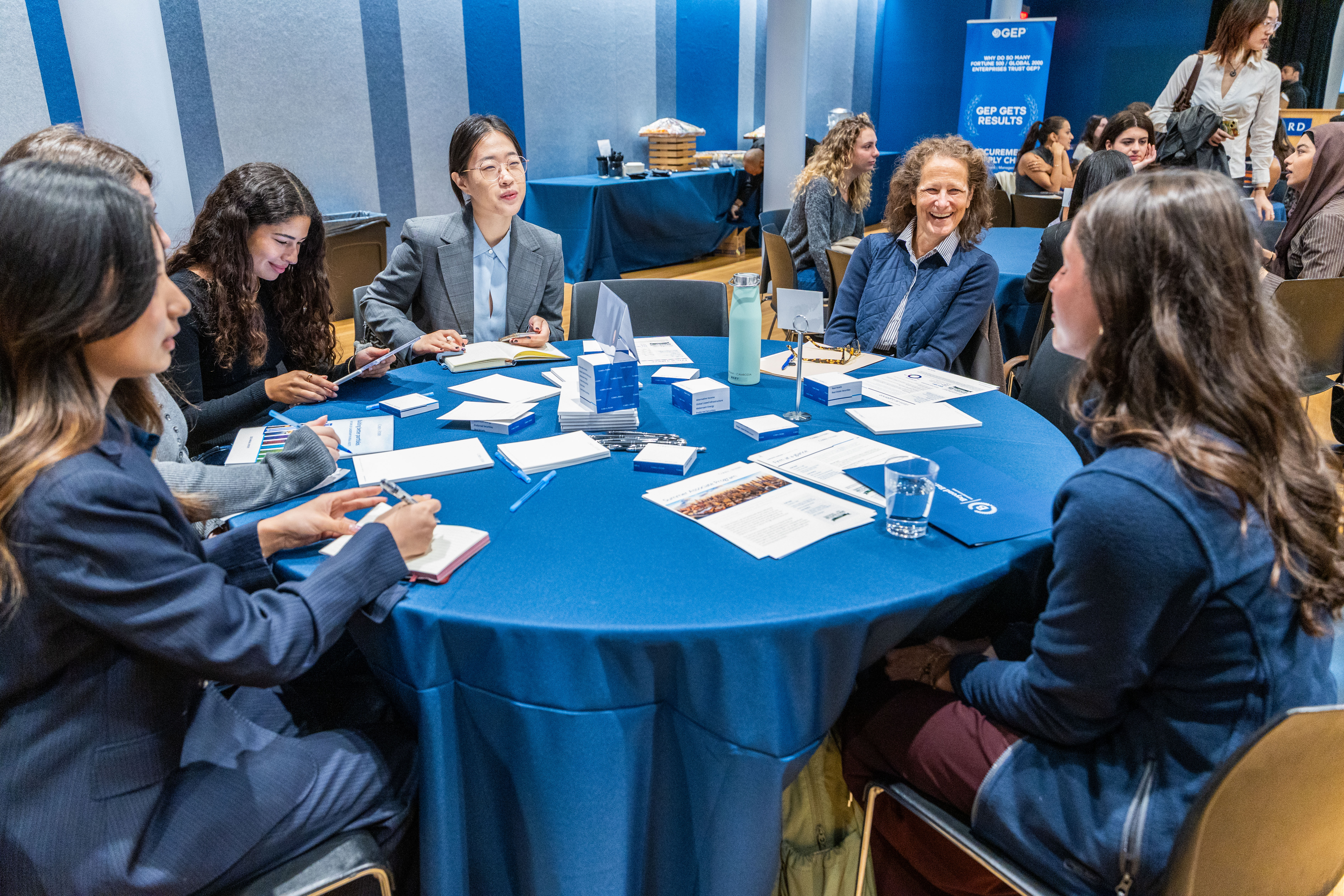
On Sept. 25, Barnard hosted its 2026 Opportunities Conference, bringing students, alumnae, employers, and graduate school recruiters together on campus to prepare the next generation for the workforce. This year’s event centered on navigating career paths in the age of artificial intelligence. More than 600 Barnard students registered to meet face-to-face with employers and visiting mentors — an invaluable experience in an increasingly digital world.
“The Opportunities Conference is Barnard's largest annual career event,” said Amanda Dye, executive director of Beyond Barnard. “It is always such a special occasion because it allows us to quite literally see the strength and vibrancy of Barnard’s community during a day of exciting and affirming conversations.”
More than 60 employers, alumnae, parents, and friends of the College participated in the conference this year, including representatives from Aon (which sponsored the conference), Penguin Random House, The Rockefeller University, Goldman Sachs, Credit Agricole, Salesforce, and the New York State Department of Civil Service — among many others.
For the first time, Beyond Barnard also partnered with the Alumnae Association of Barnard College to align the conference with Barnard’s Leadership Assembly, the annual gathering of current and prospective alumnae volunteers. The coordination of both events drew the largest alumnae turnout in the Conference’s history, expanding networking opportunities for students.
One of the most distinctive aspects of the Opportunities Conference is its format. Students schedule 25-minute small-group conversations with visiting employers, recruiters, and alumnae. This is a radical departure from the long lines and rapid-fire interactions that characterize traditional career fairs.
“Our staff, faculty, and students benefit immensely from the unity and vitality of the network represented on campus during the conference,” said Dye.
Adelina Ramirez ’29, a sociology major on the pre-law track and a 2026 Laidlaw Scholar, pointed to the small-group format as the conference’s biggest advantage over a typical career fair. “The one-on-one meeting format allows students to have more meaningful conversations and engage with professionals in a way that can feel less overwhelming than a large career fair,” said Ramirez.
“The young women at Barnard are creative, ambitious, and driven, and events like the Opportunities Conference create a space for those qualities to connect across classes and generations,” Ramirez added.
Devon Kroupa-Haberski ’27, a biochemistry major planning to attend medical school, appreciated the specialized insight she received. “I found it very interesting to talk to two Barnard graduates [Dr. Jennifer Mathur ’96 and Dr. Mia Mattioli ’09] who both have highly specialized degrees, yet both emphasized how important Barnard's well-rounded education has been to set them up for such high specialization,” said Kroupa-Haberski.
Karissa Song ’28 noted the power of shared experience. “During the career conversations, I really enjoyed speaking to alumnae and hearing more about how they got to where they are, and how Barnard shaped their career pathway,” said Song. “I think Barnard women have this universal drive and motivation. These people were once where I was and now they’re passing their wisdom down to me.”
The conference also featured a packed keynote panel discussion titled “AI, the Liberal Arts, and the Future of Work,” moderated by Maryam Banikarim ’89, P’21, co-founder of The Longest Table. The panel members included Debbie Lovich ’89, managing director and senior partner of Boston Consulting Group; Annie Dean, a global transformation leader and future of work expert; and Smaranda Muresan, associate professor and acting chair of the College’s Department of Computer Science.
The three panel members addressed pressing questions such as, “How must liberal arts institutions like Barnard continue to innovate to prepare graduates for lifelong success in a range of industries?” and “What does the future of gatherings like the Opportunities Conference look like?” Typical of these annual keynote discussions, the theme drew on a source of both anxiety and opportunity for current students.
“My overarching message for students and alumnae here today is that humans will still be required in the workforce. AI is changing a ton, but it will not replace humans,” Lovich, author of Make Work Work, shared after the panel. “The most important skills and attitudes we can take into the future of work is the ability to learn, shape, and grow because flexibility is important. A liberal arts education is great training for that.”