Alumnae Auditing Program
Alumnae Auditing Program
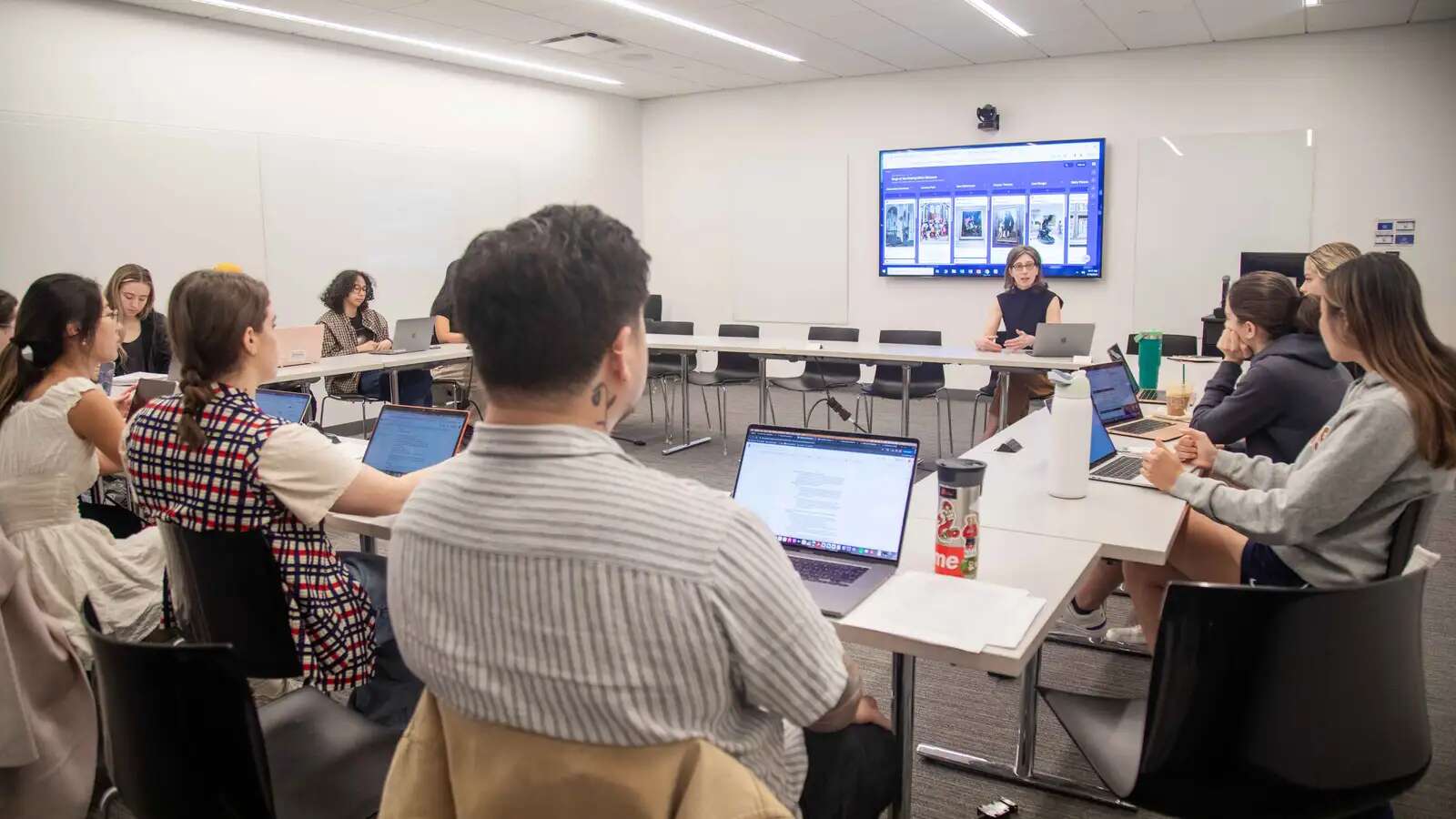
Barnard|Next is the home for Barnard’s expanded Alumnae Auditing Program. As a Barnard alumna, you can return to the classroom, explore a curated selection of courses, and learn alongside the next generation of Barnard students. It is a chance to reconnect with academic life and with campus while continuing to pursue ideas across disciplines without the pressure of grades.
Auditors attend lectures, engage with faculty and students, and follow the intellectual arc of a course from start to finish, without graded assignments or exams.
Eligibility
-
Open to Barnard alumnae in good standing.
-
A curated list of eligible undergraduate courses is set each semester.
-
Participation of auditors is at the discretion of each instructor and depends on available classroom space. Current students are always prioritized for seats.
Fall 2026 Course Offerings
Interpretation of Culture (ANTH 1002UN)
Brian Larkin
MW 10:10 - 11:25 AM
The anthropological approach to the study of culture and human society. Case studies from ethnography are used in exploring the universality of cultural categories (social organization, economy, law, belief system, art, etc.) and the range of variation among human societies.
Origins of Human Society (ANTH 1007UN)
Camilla Sturm
TuTh 11:40 AM - 12:55 PM
An archaeological perspective on the evolution of human social life from the first bipedal step of our ape ancestors to the establishment of large sedentary villages. While traversing six million years and six continents, our explorations will lead us to consider such major issues as the development of human sexuality, the origin of language, the birth of “art” and religion, the domestication of plants and animals, and the foundations of social inequality. Designed for anyone who happens to be human.
Clothing (AHIS 3667BC)
Anne Higonnet
MW 10:10 - 11:25 AM
Human beings create second, social, skins for themselves. Everyone designs interfaces between their bodies and the world around them. From pre-historic ornaments to global industry, clothing has always been a crucial feature of people’s survival, desires, and identity. This course studies clothing from the perspectives of anthropology, architecture, art, craft, economics, labor, law, psychology, semiotics, sociology, and sustainability. Issues include gender roles, local traditions, world-wide trade patterns, dress codes, the history of European fashion, dissident or disruptive styles, and the environmental consequences of what we wear today.
Evolution (BIOL 2278BC)
Rafael S Marcondes
MW 5:40 - 6:55 PM
Theodosius Dobzhansky—an influential evolutionary biologist who spent much of his career at Columbia University—famously wrote, “Nothing in biology makes sense except in the light of evolution.” Evolution underlies all biodiversity, from the COVID-19 virus to redwood trees, from New York rats to our own bodies and minds. This course introduces students to the evolutionary processes at all scales, from molecular evolution and population genetics within single species, to macro patterns of diversification and evolution in deep time as studies through phylogenies and the fossil record. The overarching goal of the course is for students to gain a solid command of the major concepts in evolutionary theory and how they are interweaved with all life around us.
Introduction to Translation Studies (CPLT 2110BC)
Peter Connor
MW 2:40 - 3:55 PM
This course will introduce students to the principal ways in which translation has been practiced and theorized in the Western tradition. We will consider, cultural, literary and philosophical theories of translation, as well as the role of translation and translators in today's globalized world. Topics covered will include: translation in the context of postcolonialism, globalization and immigration; the translation of children’s literature; subbing and dubbing in film and television, including fansubbing; translation and ecology; translation and justice; machine translation; linguistic rights; debates about mono- versus plurilingualism. We will also consider, less extensively, the place of interpreting (i.e. oral translation primarily in legal and medical settings). Specialists from the New York area will come to speak about current needs and challenges in the field of community interpreting. On the literary level, we will examine the role played by foreign languages (and translation) in the creative process of contemporary writers. We will read a number of “language memoirs,” narratives that recount the authors’ complex and sometimes agonized relation to acquiring a second language (Eva Hoffman, Xiaolu Guo, Alice Kaplan et al). For one of the assignments you will write the beginning of your own language history. We will also read and study in depth Brian Friel’s play Translations. This play is about the replacement of Irish (Gaelic) place names with English names as a result of an ordnance survey in the early 18th century. The course aims to help students improve their translation skills by translating (mostly literature) from your second language (your L2, as the linguists call it) into English, by critically assessing published translations, and by evaluating each other’s' translations-in-progress (including one of the professor's). There will be a number of guest lecturers (translators, editors, writers, interpreters, etc).
Prerequisite for the course: Intermediate or advanced level proficiency in any language other than English. This course is a foundational and required course for students wishing to complete a Translation Studies Minor.
Seeing the Body: Movement and Physicality in Modern Visual Culture
(DNCE 3240BC)
Marjorie Folkman
MW 2:40 - 3:55 PM
Investigates how shifting experiences and awareness of the body in movement, space, and time in daily city life played prominent roles in the emergence of the urban visual culture of the interwar years (1919-1939), contributing a “choreographic voice” to the age. We will also examine how contemporary interactions with visual/digital culture in the local and global spaces we inhabit relate to the tumultuous interwar visual landscape. Our lecture-format course, which includes the critical study of relevant texts, photographs, images, films, with group discussions, individual and collaborative analyses, and research projects.
American Literature 1871-1945 (ENGL 3181BC)
Jennie Kassanoff
TTh11:40 AM - 12:55 PM
This interdisciplinary course situates late nineteenth- and early twentieth-century American literature within the context of historical and cultural change. Students read works by Whitman, Twain, James, Griggs, Wharton, Faulkner, and Hurston alongside political and cultural materials including Supreme Court decisions, geometric treatises, composite photography and taxidermy.
American Literature to 1800 (ENGL 3179BC)
Lisa Gordis
MW 10:10 - 11:25 AM
This course surveys American literature written before 1800. While we will devote some attention to the literary traditions that preceded British colonization, most of our readings will be of texts written in English between 1620 and 1800. These texts--histories, autobiographies, poems, plays, and novels--illuminate the complexity of this period of American culture. They tell stories of pilgrimage, colonization, and genocide; private piety and public life; manuscript and print publication; the growth of national identity (political, cultural, and literary); Puritanism, Quakerism, and Deism; race and gender; slavery and the beginnings of a movement towards its abolition. We will consider, as we read, the ways that these stories overlap and interconnect, and the ways that they shape texts of different periods and genres.
Global Literatures in English (ENGL 3521BC)
Atefeh Akbari
TuTh 5:40 - 6:55 PM
The title of this course suggests that there are literatures across the “globe” written in English, and that we will study them. But this statement rests on a series of assumptions: the a priori existence of a globe with latitudes, longitudes, and borders; a singular category of “literature” produced in different geographical locations across the globe; and finally, that these literatures are written in English. During the course of the semester, we will investigate and (occasionally overturn) all three of these assumptions.
In order to do so, we will read across different literary genres (short stories and novels, plays, poetry, and essays), while also reading texts that move between these genres or defy them altogether. We will read texts that were originally written in English, as well as texts that have been translated into English, and we will learn and discuss the term “global anglophone” along with the ways in which this term has been challenged. During our collective readings and discussions, we will map the locations that arise in each text and the locations out of which these texts arise. We will study the relationship between literature, translation, and mapping, and we will learn and discuss the concept of planetary thinking and writing as an alternative to border and global thinking.
Colonial Encounters: Europe & the Culture of Empire (HIST 2321BC)
Lisa Tiersten
MW 10:10 - 11:25 AM
Examines the shaping of European cultural identity through encounters with non-European cultures from 1500 to the post-colonial era. Novels, paintings, and films will be among the sources used to examine such topics as exoticism in the Enlightenment, slavery and European capitalism, Orientalism in art, ethnographic writings on the primitive, and tourism.
The United States: 1940-1975 (HIST 2413BC)
Mark Carnes
MW 11:40 AM - 12:55 PM
Emphasis on foreign policies as they pertain to the Second World War, the atomic bomb, containment, the Cold War, Korea, and Vietnam. Also considers major social and intellectual trends, including the Civil Rights movement, the counterculture, feminism, Watergate, and the recession of the 1970s.
Calculus I (MATH 1101UN; Section 01)
Marco Castronovo
MW 11:40 AM - 12:55 PM
Functions, limits, derivatives, introduction to integrals, or an understanding of pre-calculus will be assumed.
Calculus I (MATH 1101UN; Section 03)
Marco Castronovo
MW 10:10-11:25 AM
Functions, limits, derivatives, introduction to integrals, or an understanding of pre-calculus will be assumed.
Introduction to Music (MUSI 1001BC)
Gail Archer
MW 2:40 - 3:55 PM
No previous knowledge of music is required. A survey of the development of Western music from 6th-century Gregorian Chant to Bach and Handel, with emphasis upon important composers and forms. Extensive listening required.
Introduction to Neuroscience (NSBV 1001BC)
BJ Casey
TuTh 8:40 - 9:55 AM
This course is required for all the other courses offered in Neuroscience and Behavior. The course introduces students to the anatomy and physiology of the nervous system. The topics include the biological structure of the nervous system and its different cell types, the basis of the action potential, principles of neurotransmission, neuronal basis of behavior, sleep/wake cycles, and basic aspects of clinical neuroscience.
Cellular and Molecular Neuroscience (NSBV 3361BC)
Alexis Hill
TuTh 10:10 - 11:25 AM
This upper-level lecture course provides an in-depth analysis of neuroscience at the molecular and cellular levels. Topics include: the structure and function of neuronal membranes, the ionic basis of the membrane potential and action potential, synaptic transmission, synaptic plasticity, and sensory transduction.
Introduction to Philosophy of Language (PHIL 2685UN)
Karen Lewis
TuTh 11:40 AM - 12:55 PM
This course gives students an introduction to various topics in the Philosophy of Language.
Forensic Psychology (PSYC 2178 BC)
Kathleen Taylor
TuTh 10:10-11:25 AM
Every day there are thousands of individuals interacting with the legal system. Are
they mentally competent to stand trial? How can a judge decide if it is in the best
interests of a child to live with one, or both (or neither) parent(s)? What is the risk of
a violent offender repeating the offense? What kinds of information influence juries?
Does mediation work to solve disputes? Forensic psychologists apply their
knowledge of psychology specifically in legal matters. This semester will focus on
the broad area of forensic psychology, exploring important legal cases relevant to
forensic psychology, police psychology, what constitutes expert testimony, how
assessments are conducted, and working as a psychologist in the correctional system.
Forensic Psychology (PSYC 2178 BC)
Kathleen Taylor
TuTh 10:10-11:25 AM
Every day there are thousands of individuals interacting with the legal system. Are
they mentally competent to stand trial? How can a judge decide if it is in the best
interests of a child to live with one, or both (or neither) parent(s)? What is the risk of
a violent offender repeating the offense? What kinds of information influence juries?
Does mediation work to solve disputes? Forensic psychologists apply their
knowledge of psychology specifically in legal matters. This semester will focus on
the broad area of forensic psychology, exploring important legal cases relevant to
forensic psychology, police psychology, what constitutes expert testimony, how
assessments are conducted, and working as a psychologist in the correctional system.
Fall 2026 Timeline
- August 11, 2026 – Fall 2026 Alumnae Auditing Program application opens. Submit your form and indicate your course preferences.
- September 8, 2026 – Fall 2026 classes begin. If there is space in your requested course, you will receive an email with preliminary permission to attend. Barnard students are still in the add/drop period, so your seat is not yet confirmed. If your first-choice course is full, you will be asked to select an alternate. Please do not contact instructors directly about space.
- September 21, 2026 – You will receive a registration confirmation email if you are officially registered as an alumnae auditor. This email will include payment instructions for tuition and fees.
- September 28, 2026 – Payment deadline. Use the link in your confirmation email to pay online.
Program Fees
Barnard alumnae receive significant discounts on tuition when they participate as auditors. Fees vary based on graduation year and course credits.
Alumnae who graduated on or before February 1984
- Course management fee: $250. This fee covers administrative costs associated with hosting auditors. There is no additional tuition charge for the course.
Alumnae who graduated on or after May 1984
- 3 credit course tuition: $1,828.00
- 4 credit course tuition: $2,437.00
- Course management fee: $250
Tuition for auditors reflects a 75% discount from standard tuition rates. The course management fee covers campus access and access to online learning platforms for the duration of the course.
Questions about fees can be directed to barnardnext@barnard.edu.