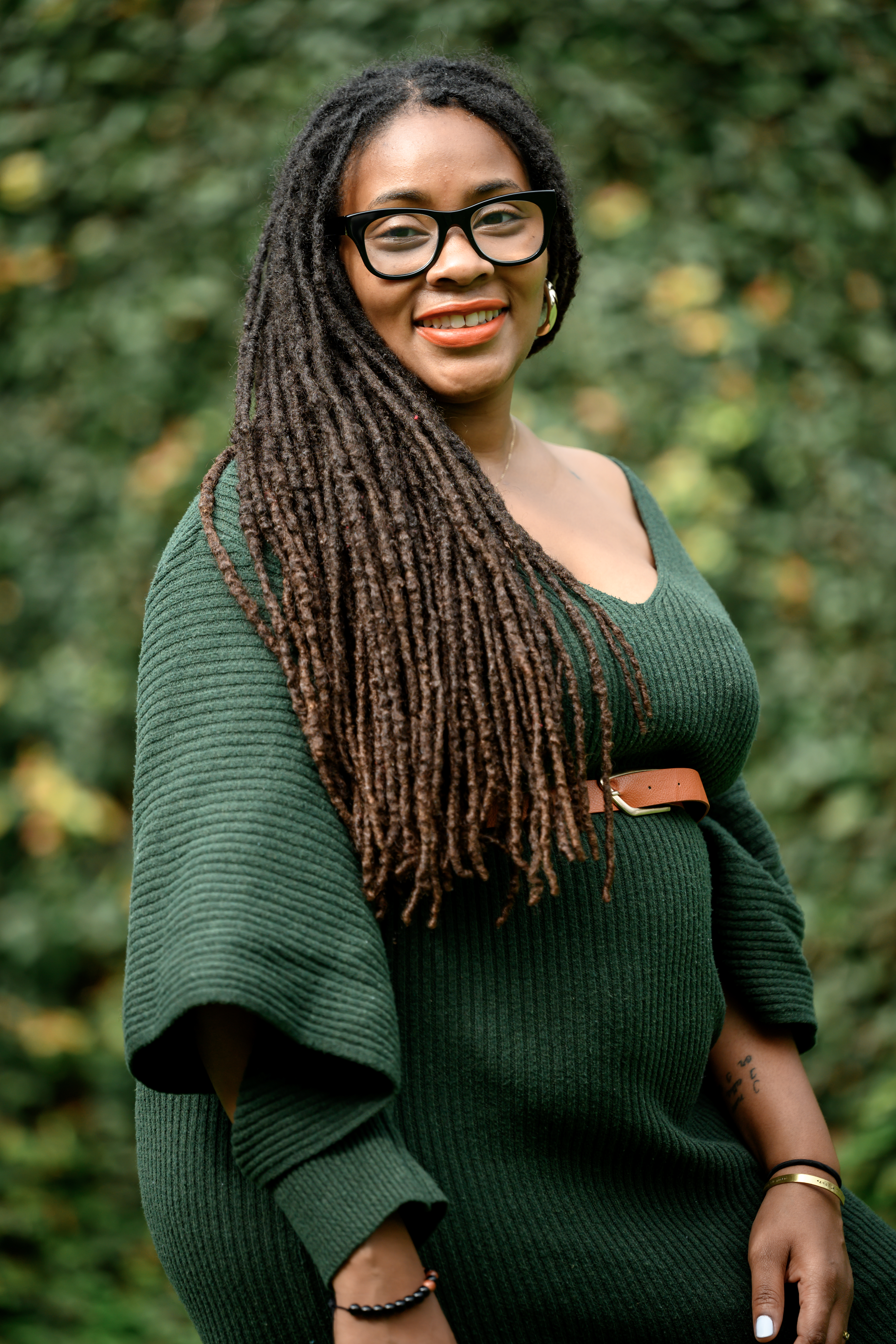
By Nafeesah Allen
I arrived at Barnard certain I wanted to study political science, but uncertain about what avenues that degree could offer. I’d always imagined myself as an artist and a writer — New York was the right place for that dream — but I also carried a track record of leadership, strategic initiative, and problem-solving far beyond my years.
Still, when people asked what I’d do after graduation, I learned to smile and say, “We’ll cross that bridge when we get there.”
That bridge came sooner than expected. Within a year, the political science track felt distant. The canon was rooted in theorists who lived far from the world I knew — men who imagined ideal democracies without confronting the hypocrisies of their own societies. As we debated abstract questions about governance and freedom, I knew these theories had never been designed with communities like mine in mind.
Growing up in Newark, New Jersey, I saw politics as proximity. The mayors and city council members who showed up at football games and graduations, who pushed anti-violence programs, who fought for anti-redlining policies and affordable housing were not theorists — they were doers. And behind them, always, were Black women who strategized, organized, absorbed losses, and kept communities alive with grit and tact. I knew I came from that lineage, but Barnard helped me understand the many shapes that could take.
The punchline?
Systems for the advancement of women feel fixed until someone reimagines them. That someone could be me.
I found my intellectual home in what is now Africana Studies. The department at Barnard was young, but its curriculum was expansive — diasporic in every sense. Courses crossed languages, geographies, and disciplines, echoing the scattered yet interconnected stories of the Black world.
Professors like Kaiama Glover, Caryl Phillips, C. Daniel Dawson, and the late Quandra Prettyman taught me that culture, politics, memory, and imagination are inseparable. Their classes gave me theory rooted in lived experience and affirmed that scholarship, creativity, and community responsibility can — and must — coexist.
By my sophomore year, I had completed my Africana Studies requirements and moved on to add a second major in Spanish and Latin American literature. I earned the prestigious Thomas R. Pickering Foreign Affairs Graduate Fellowship Program, through the State Department, and concluded a Master's of International Affairs at Columbia’s School of International Affairs.
Diplomacy calls me to anticipate crises before they erupt, to build relationships that bridge differences, and to make difficult decisions with humility and clarity. It also awakens something deeper in me: the desire to tell stories about continuities across seemingly disparate times and places. That impulse led me back to diaspora scholarship—earning a second master’s in India and completing my doctorate on Mozambique—and pushed me forward into creative practice as a Research Associate at the University of the Witwatersrand in Johannesburg.
Today, I publish widely on diaspora identities, postcolonial politics, and Afro-Asian cultural exchange, and I create art that draws from thousands of my original photographs and globally collected material culture. In these myriad ways, I explore the world as it is, not how theorists say it should be. That ethos underpins my diplomatic career, my academic research, and my art.
In the end, that’s the work: finding the points of connection from which a bridge can be built strong enough to support our full weight, and walking across it — shakily but steadfastly — toward whatever comes next.
My advice to future Barnard alumnae is simple: have the audacity to leverage synergy.
Barnard taught me not just to study the world, but to shape it. And that work is never done.