This spring, the Curiosity Initiative, launched by the Center for Engaged Pedagogy and the Office of the Provost with generous support from a gift by Jane Jelenko ’70, brought two speakers to campus to explore curiosity and its complexity from several disciplinary perspectives and across many different practices.
The initiative is one of the many ways Barnard prepares students to encounter unfamiliar ideas, challenge what they already know, and pursue questions with openness and courage. The program aims and invites the Barnard community to ask bold questions: What does curiosity look like across different academic fields? How do professors nurture curiosity in classrooms, labs, and studios alike? And how do we reshape our curiosity when we are caring for others or navigating moments of conflict?
Alex Pittman, Senior Associate Director at the Center for Engaged Pedagogy, said that the spring series included perspectives from History and Gender, Sexuality, and Feminist Studies, highlighting how curiosity is applied in teaching, research, and across disciplines.
“While both talks this semester were very different in subject and approach, they shared an interest in how curiosity relates to narrative — indeed, how curiosity attunes us to the presence of multiple, interweaving narratives in whatever it is that we study,” Pittman said.
“In doing so, our speakers encouraged us to reflect not only on how curiosity helps us encounter new questions in our research and teaching. They also encouraged us to understand curiosity as a resource for navigating and narrating richly complicated social worlds,” Pittman added.
This spring, the initiative drew a crowd of more than 100 people, including eight full-time faculty who participated in a community of practice oriented around curiosity-driven approaches to teaching and course design.
"Curiosity, Complexity, and the Pedagogy of Israel-Palestine"
The first speaker of the Spring series was David N. Myers, P’14 ’16, a Distinguished Professor of History and holds the Sady and Ludwig Kahn Chair in Jewish History at UCLA.
Myers spoke in depth about a seminar he co-teaches with professor Nadim Rouhana, Issam M. Fares Chair in Lebanese and Middle Eastern Studies at the Fletcher School of Law and Diplomacy at Tufts University that uses a multi-narrative approach, unique speakers and open dialogue to discuss the pedagogy of Israel-Palestine.
The class was born out of a need for students to have a safe space to hold hard conversations with divergent perspectives about the Israeli–Palestinian conflict. Students have emerged from the seminar with an enhanced sense of nuance and a greater deal of curiosity with the ability to engage – rather than avoid – tough topics, according to Myers.
“Precisely at this moment, when we are encouraged to remain within the safe confines of our silos, it is important to build up the muscle of curiosity, conversation, and dialogue,” Myers said.
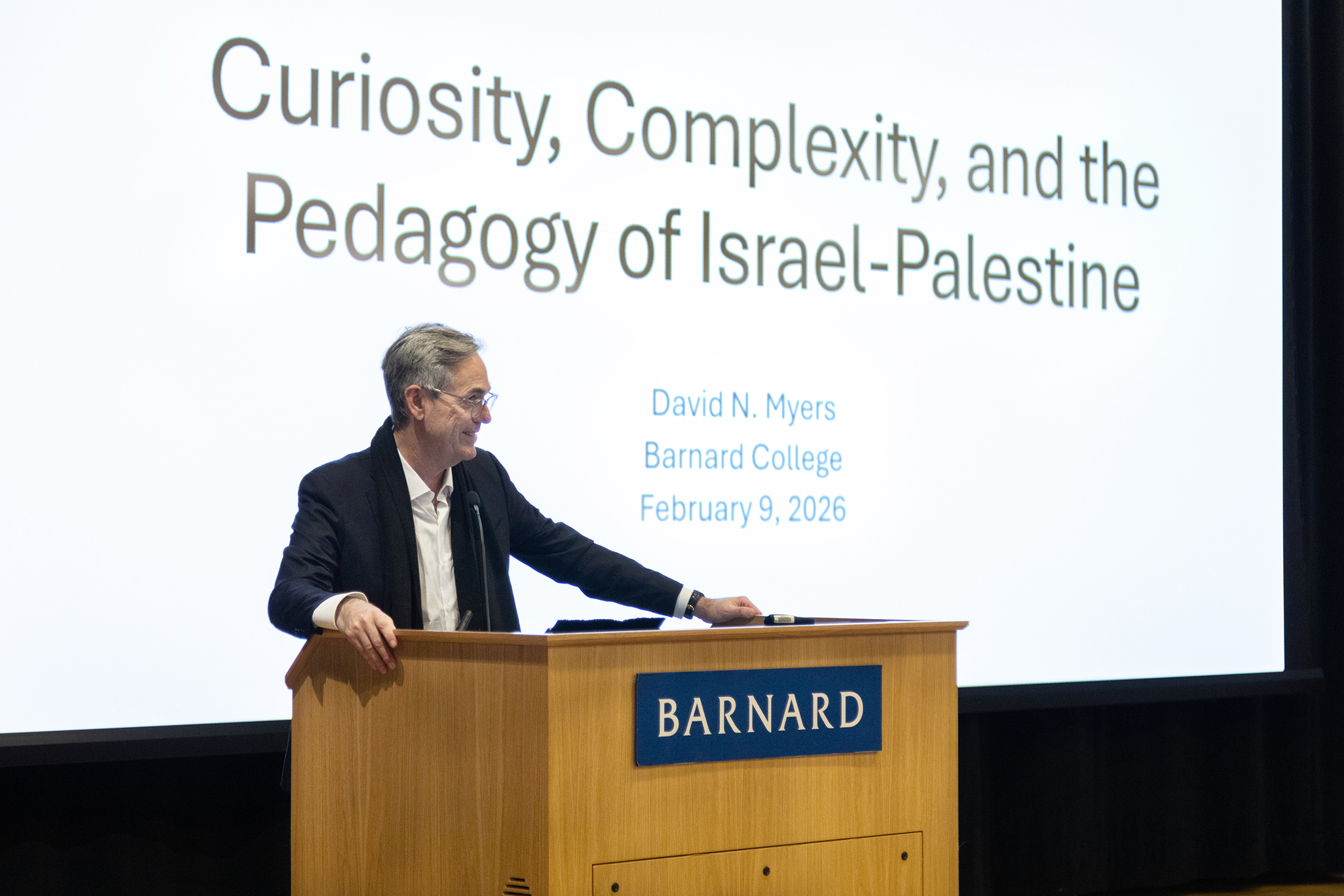
“Institutions of higher education are built on the spirit of productive dialogue and disagreement — and if we cease to engage in them, we will wither. Our mission is to reap the benefits of our collective curiosity in order to produce new bodies of knowledge in order to better society,” he added. “I love that Barnard has taken the lead with the Curiosity Initiative, and I am honored to participate in it.”
"Writing From Home"
The next speaker in the Spring Lecture series, Jennifer C. Nash, is a four time published author and the Jean Fox O'Barr Professor of Gender, Sexuality, and Feminist Studies at Duke University.
Nash spoke about how the roles of surprise, uncertainty, and playfulness in Black feminist scholarship could expand our understanding of curiosity.
Nash spoke at length about Black feminist theory, loss, and how it feels to slowly lose someone, her mother, who is still physically present – to Alzheimer's. She also spoke to how Black women, like the mother of Emmett Till, Mamie Elizabeth Till-Mobley, or Coretta Scott King, often become tethered to loss.
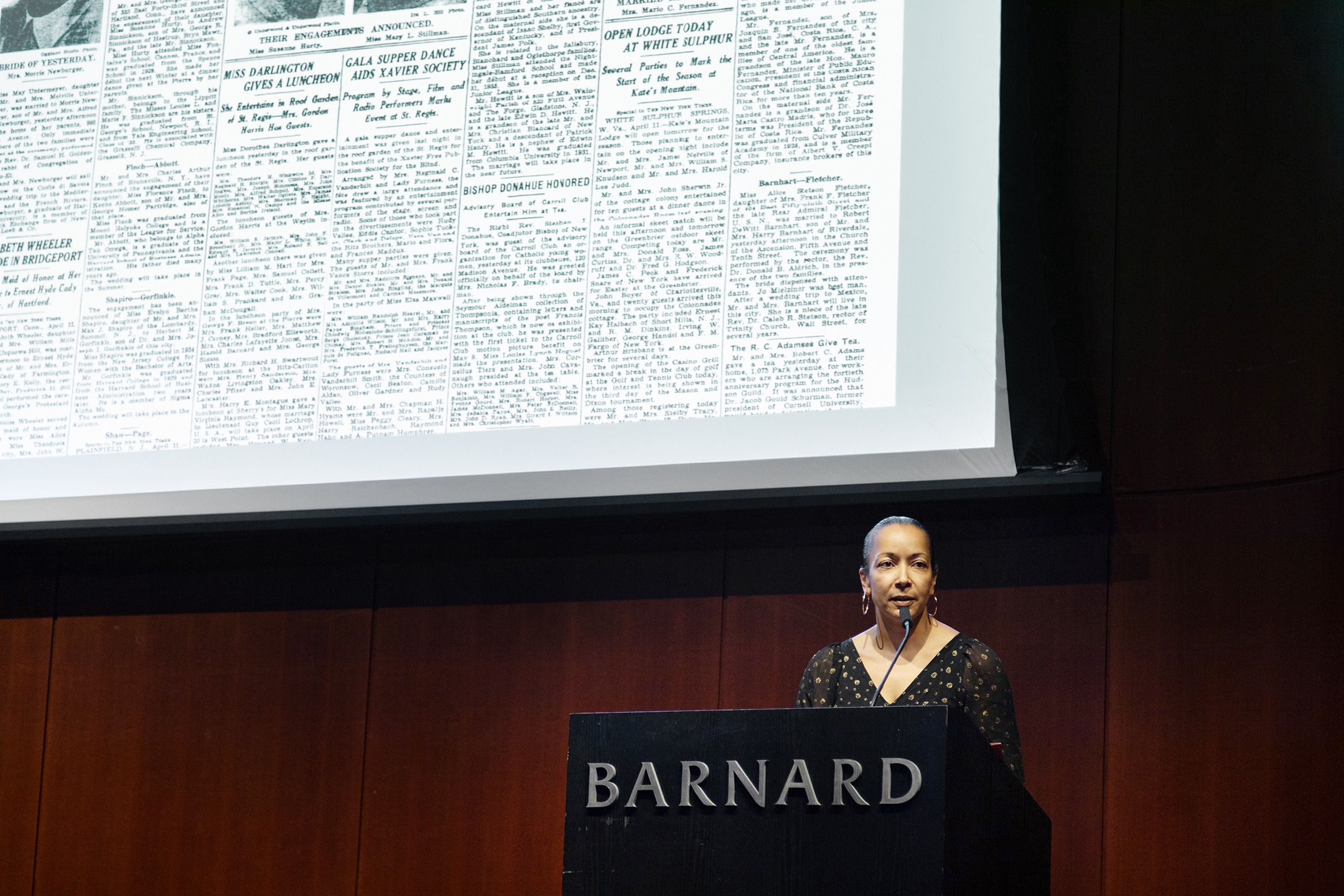
Her book,How We Write Now examines loss through the lens of Black feminism while also tracking and unraveling her own loss with her mother due to Alzheimer's. Nash said she realized the lack of literature on Alzheimer's and losing a person in the Black space and that’s where the journey began to write the book.
“The invitation to speak at Barnard’s Curiosity Initiative sparked my desire to share new work, and work that feels quite different from my academic research,” Nash said, following her lecture. “I’m grateful for the framework of curiosity that Barnard offered, which promoted me to think about playfulness and uncertainty, and the beautiful risks of doing new kinds of work.”
The Curiosity Initiative launched at the start of the 2025-2026 academic year. It will continue throughout the 2026-2027 academic year.