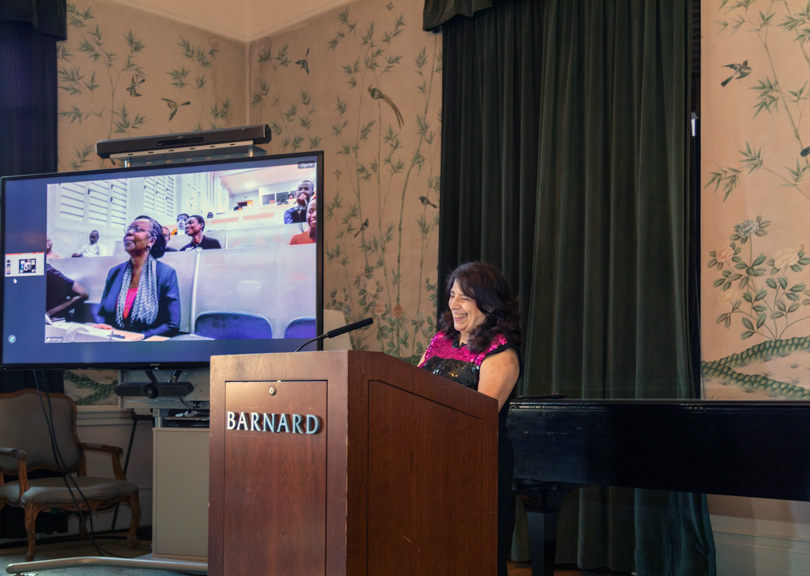
Listeners from around the world tuned in to be part of Barnard Next’s Authors’ Shelf, a program which connects various alumnae and faculty with the Barnard community, providing them with a platform to share their published works, research, and life stories.
Ilise Feitshans ’79, led the Nov. 18 lecture on nanotechnology and global health disparities. The discussion included Dean Pulcherie Amougi Galaoua of Catholic University of Central Africa participating via Zoom. The lecture gave a large group of her students in Africa their first exposure to Barnard.The pair communicated in French, with Feitshans translating for English-speaking Barnard attendees from campus in the Salzburger Parlor. For Feitshans, this was a continuation of the pathbreaking research she had begun at Barnard as an undergraduate, when she was fascinated by the role of law in society and the ability of emerging science to serve as the catalyst for creating important social change.
Attendees of the conversation included a doctor in Uganda, a former member of the USA National Nanotechnology Coordinating Office, several scholars in France and Switzerland, and more.
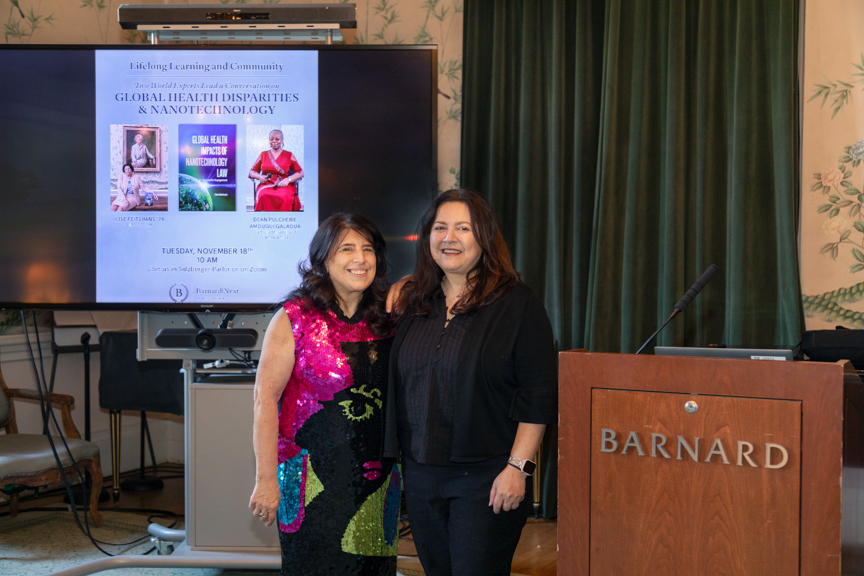
Feitshans, a highly accomplished lawyer specializing in public health and nanotechnology, hoped to spark a vital dialogue on how prevalent nanotechnology is in our world, and how we can best utilize it to our advantage. The conversation focused largely on how new technology operationalized the right to health under national and international laws, much of which is detailed in Feitshans’s book, Global Health Impacts of Nanotechnology Law. Nanotechnology has been marketed for years as new medication, stronger packaging to protect goods from contamination, stronger mascara, long-lasting lipstick, and more. “Nanotechnology is part of daily life — whether we realize it or not,” said Feitshans.
She emphasized the importance of understanding how nanotechnology affects us all — and how many nanoparticles are contained in clothing, food, cosmetics, and more. While nanotechnology laws and restrictions are somewhat a murky field, Feitshans works to realize the benefits of nanotechnology while simultaneously minimizing the risks.
Globally, women’s health tends to lag behind men’s at every stage of the life cycle. Nanotechnology helps emphasize this disparity. Many products containing nanoparticles are marketed toward women — certain clothing, cosmetic items, and diet products, furthering the gap between men’s and women’s health.
There are also certain benefits to nanotechnology which can help levelize access for vulnerable populations, when utilized in a specific way. “Technology is always an equalizer,” Feitshans said. Benefits of nanotechnology include better solar cells and batteries, and advancements in medicine. Agrivoltaics and nanotechnology combine to create nanotechnology-enhanced solar panels to optimize light for energy production and plant growth — a potential solution for food insecurity. "I believe that science and technology can solve a remarkable percentage of problems previously viewed as intractable," said Feitshans.
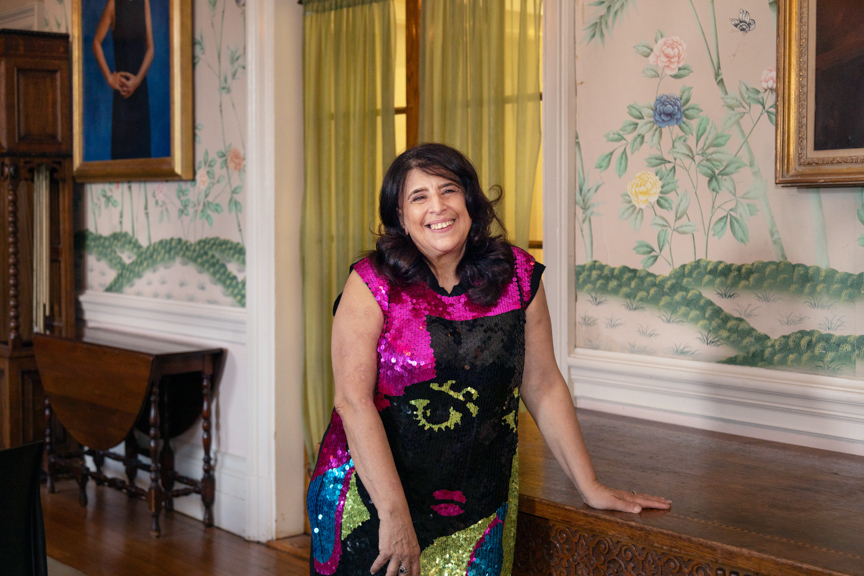
Feitshans’s fervor for the topic was notable throughout the discussion, even when speaking another language. “At times she spoke in French — which I could not fully understand — but the passion, clarity, and gist of her message were unmistakable,” said Vinod Kumar Singh, an attendee observing from India.
Feitshans plans to return to Barnard’s campus next year, with the addition of a Barnard Next course titled "Beauty, Babies, and Dieting," which aims to emphasize the omnipresence of nanoparticles in our modern world and products. The class will further drive home the disparity between men and women’s health in terms of exposure to nanoparticles, a lifelong mission of Feitshans. “We are capable of eliminating women's health disparities using the new technologies that use nanoparticles," said Feitshans.
“[This topic] was envisioned in my thesis almost half a century ago,” she said. “It just took other people a long time to get ready to listen.”
Barnard alumnae, like Feitshans, are consistently breaking the mold across disciplines. Feitshans credits much of her career accomplishments to her experience at her alma mater. “Barnard College's ethos has been a powerful dynamic engine driving my life,” she said. “Barnard alumnae are a global resource for pathbreaking ideas and insatiable curiosity about how to fix whatever is wrong with this world that we deem important.”