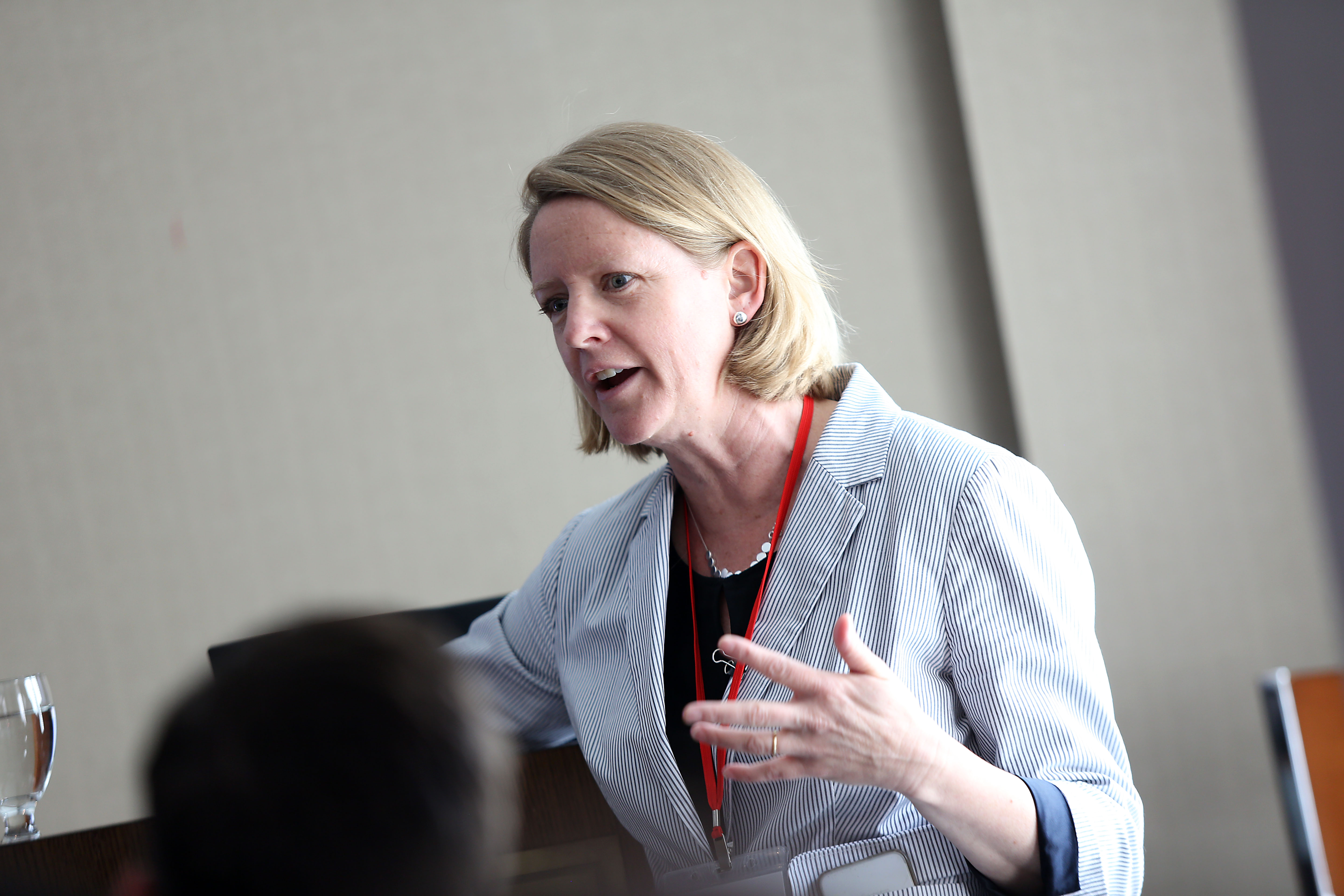
Stephanie M. Jones ’92, the newly appointed faculty director of Harvard University’s Center on the Developing Child, envisioned her career long before it started — or even knew that it was a field someone could enter. “I was constantly noticing and wondering about the things that shape how children learn and grow,” she said, thinking back to her own childhood. “How does a child get from an infant to a toddler to a kindergartener?”
These questions followed Jones through middle school, where she and a friend ran a makeshift summer camp for neighborhood kids, and to the psychology department of Barnard College, where cultivating intellectual curiosity remains a core value. Her application essay, she remembers, was about better understanding the structural issues that allow some children to thrive and cause others to struggle.
The experiences she had at Barnard changed her life completely, Jones said. She found an early mentor in professor of psychology Lawrence Aber, then the director of the Barnard Center for Toddler Development, the College’s nationally-recognized research, education, and training center for children under three.
In the nineties, Aber was interested in “school-based violence prevention,” which would later transform into conversations about social and emotional learning, including the importance of developing non-academic skills like focus and resilience early in life.
“From that moment, a lightbulb turned on,” Jones said. “I realized that I could devote a career to children’s health and well-being that was not necessarily teaching.”
Jones explains social and emotional learning like this: Imagine a group of children sitting on a rug, listening to their teacher read a book. The children are listening to the words and making sense of the story, but that is the tip of the iceberg. To be successful in that moment, a child must be able to focus. To shift their attention and manage their behavior. To feel like a welcome member of the group. To be attuned to their emotional experience. “Those skills are part of learning, and can’t be separated from what’s happening in the classroom,” she said.
After graduating from Barnard, Jones was brought on full-time with the Toddler Center. She remained in various research capacities for a number of years before leaving to facilitate studies at the National Center for Children in Poverty, which was then located at the Columbia University Mailman School of Public Health.
In 1998, Jones traded New York for New Haven to pursue a doctorate in developmental psychology at Yale University. There, she worked with Edward Zigler, often referred to as the “father of Head Start,” the landmark government program that provides needs-based support to expectant parents, infants, and toddlers. Zigler was a pioneer of academic research in Jones’s areas of interest, and a fierce advocate for affordable childcare and better conditions for working families.
For Jones, joining the Harvard Graduate School of Education in 2007, and eventually becoming faculty director of Harvard University’s Center on the Developing Child in 2026, was the natural culmination of a decades-long career in child development. The Center links evidence from research scientists to effective policies and practices, working to close the gap on disparate outcomes for children and families. It is as much about providing clear insights to people in positions of power as it is about the academic heft, ensuring that those making critical decisions are armed with the right information.
Jones’s lab at Harvard, the Ecological Approaches to Social Emotional Learning (EASEL) Laboratory, focuses its attention on applied settings like schools and communities, exploring how relationships between individuals and their broader social context influence children’s social, emotional, and behavioral development. EASEL has produced studies in afterschool settings across the U.S., but also classrooms in Lebanon and Ukraine.
“This kind of work is what I fantasized about my entire career,” said Jones. “Using science and evidence to support children and families, making a difference in how people out in the world — not just scientists — think about and understand child development.”