This spring, Barnard students will have the rare opportunity to sit inside immigration courtrooms and see the system at work for themselves. Thanks to a $75,000 grant from the Incite Institute at Columbia University, the data they gather will become part of a newly-funded research project that aims to provide a better understanding of how justice is implemented in the court system.
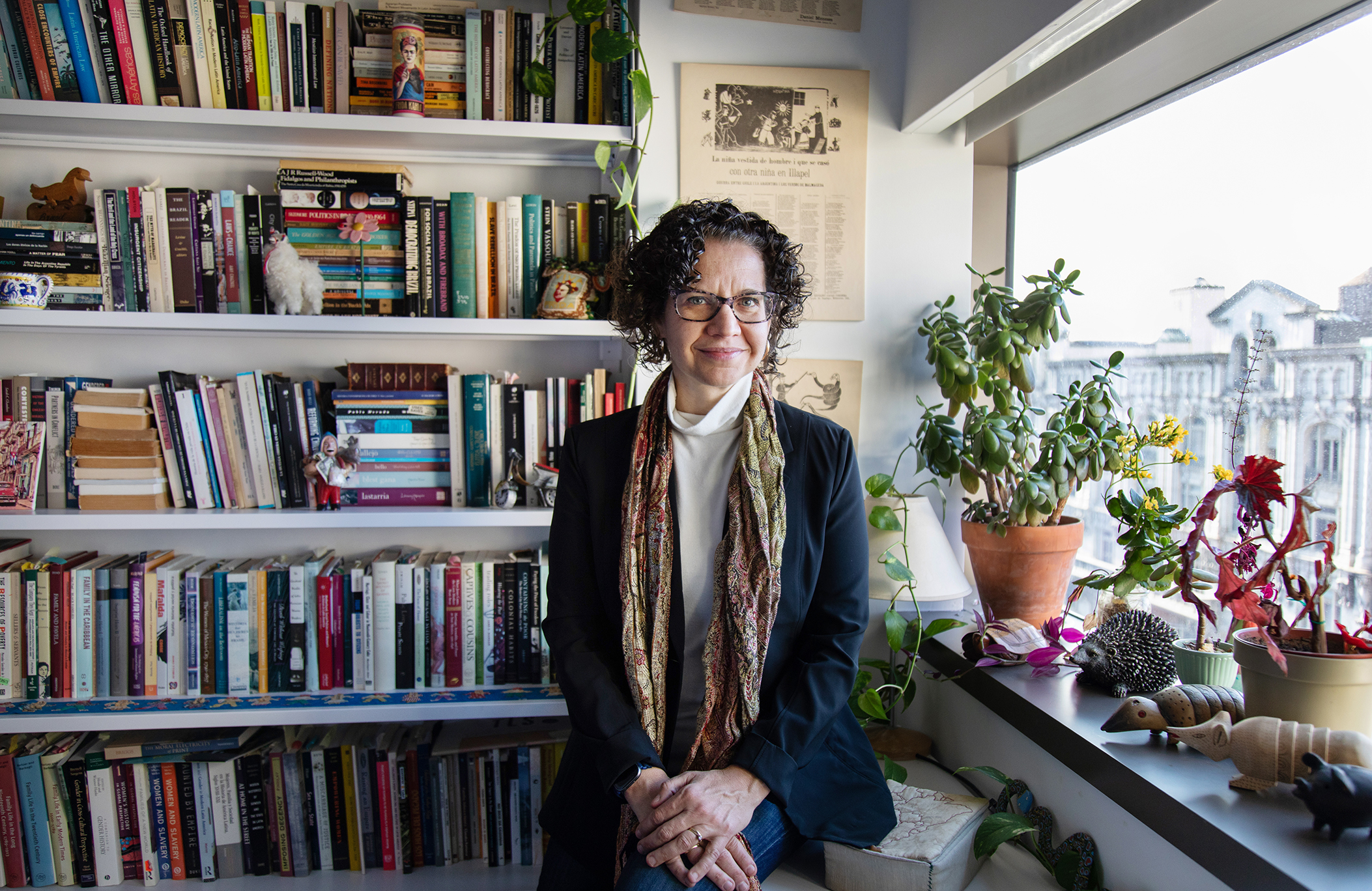
The project, titled “Hidden Justice: An Ethnographic Examination of U.S. Immigration Courts,” will be led by Professor and Chair of History Nara B. Milanich. As Team Lead, Milanich will build on her research interests in law and social inequity, with previous scholarship focusing on modern Latin America. The grant, awarded in 2025, is funded by the Institute's “Hard Questions” program, an initiative dedicated to funding research that examines complex issues through unconventional methods.
“These courts are a black box — we often have no idea what goes on inside them, but we do know that there are radically different outcomes in cases across the country,” said Milanich. “How strong was the interpreter? How does the judge interact with the respondent? What is the government attorney doing? Sending an ethnographer into the courtroom allows us to observe what is happening on a granular level.”
Using an ethnographic approach — the anthropological practice of observing and recording cultural phenomena — “Hidden Justice” aims to shed new light on immigration courts in the United States, using empirical insights to better understand how justice is interpreted, negotiated, and enacted in court proceedings.
Data from different courts will be drawn from the observations of over 100 student ethnographers, who will be trained at their respective institutions. Those working on the project from other institutions include Amelia Frank-Vitale at Princeton University and Lauren Heidbrink at California State University, Long Beach.
Milanich noted that in addition to the ethnographic data it will generate, the project has pedagogical goals. Along with the ethnographic findings, the team will develop training and educational materials to prepare students to enter local immigration courts as ethnographic observers. In Spring 2026, Term Assistant Professor Jennifer Trowbridge will teach the course “Power, Politics, and Procedure in US Immigration Court” in the Human Rights Program, training students in “extensive, in depth, immigration court watching.” These students will participate in the national research project through visits to New York City’s three immigration courts.
“In this course, court watching becomes both a research methodology and a tool for social change,” said Trowbridge. “Each week, Barnard students will sit in immigration courtrooms, observing how justice is administered — and where justice falters. Students will document not only the outcomes of asylum cases, but the often-invisible processes that shape immigration and deportation decisions. This work couldn’t be more urgent.”
The Incite Institute is based in Columbia University’s School of Arts & Sciences and supports “unconventional ideas and a willingness to embrace experimentation” across scholarship, community engagement, the arts, and other specialties. Previous Incite projects from Barnard faculty include “The Bifurcation of Racial Justice Discourse,” led by Colin Wayne Leach, Professor of Psychology & Africana Studies, and “Afro-Nordic Feminisms,” led by Monica L. Miller, Professor and Chair of Africana Studies.