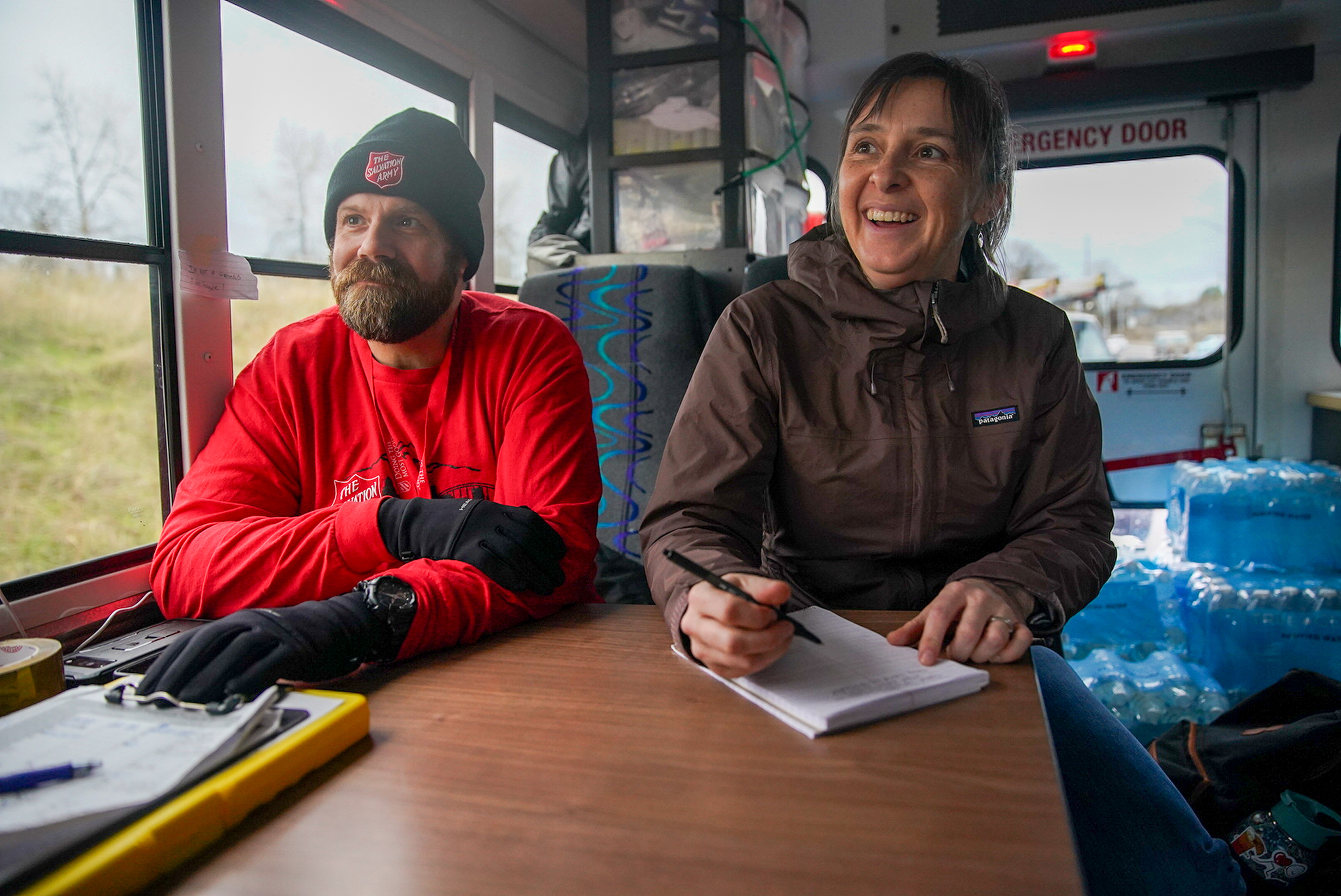
When Lillian Mongeau Hughes ’04 comes to work, each hour can look different. She might begin the day speaking to a person experiencing homelessness, hearing their stories and getting their take on the latest housing policies. If there is an announcement from local officials or a new development from homeless service volunteers, she will be on the ground to cover it. And, somewhere in the middle, she will make time to write.
Mongeau Hughes was named The Oregonian’s Homelessness and Mental Health Reporter in 2024, responsible for the paper’s coverage of homelessness in the Portland metropolitan area. It is a new beat for Mongeau Hughes, who built her journalism career covering education at The Hechinger Report — and an area of specialization with few peers, despite bridging a critical gap in information between the public and the policies that affect them.
In the United States, the number of unsheltered individuals has jumped to record highs, representing interwoven crises of affordable housing, mental health, addiction, and insufficient social services. Cities in the American Northwest like Portland, Seattle, and San Francisco are often the focal point of broader political discussions, standing in as an emblem of a complex national issue.
Barnard College spoke with Mongeau Hughes about her time as an English major, the importance of local journalism, and what people get wrong about the issue affecting hundreds of thousands of Americans.
What does an ordinary day look like for you as The Oregonian’s Homelessness and Mental Health Reporter?
I make a point of trying to get out in the world at least once per week. That could be going to a city council meeting, or interviewing the mayor, or just walking around, speaking to people living outside to get their opinion on some of the policies that are being discussed. Other times, I’m head-down writing. Right now, I’m writing up a ride-along that I did with the Behavioral Health Unit of the Portland Police. (Editorial Note: Read the published article here.)
Through this position, what have you found to be the greatest misconceptions about homelessness?
There’s the idea that all of the homelessness in our area is coming from somewhere else. I just did a story on how that’s not, in fact, the case, based on the best available data. There’s this narrative that people are coming because there are better policies here — and it might be true that we have friendlier policies, but it’s also one of the most expensive places to live in the country. It doesn’t make sense as a place to go, and that’s reflected in the data we have. We also spend a huge amount of time talking about the people on the street, but a lot of homelessness looks different than that. Homelessness can mean not having permanent housing. There is a misconception that those people don’t count.
How do you use journalism to cut through some of the avoidance people feel around this issue, reaching those who might find it difficult to have these conversations?
I’ve always been a big fan of explanatory journalism. Connecting people’s stories to the policies that explain how things happen is the form of reporting that I like doing the most, and what I’ve found to be the most powerful. I did a Q&A with a doctor at [the nonprofit] Central City Concern who treats patients with intense substance abuse issues. After stories, you’ll usually get an email or two from readers, but this time there were waves of emails thanking me for the piece. People still appreciate that about journalism — taking a question and answering it.
Can you speak to the challenges that the Pacific Northwest faces in terms of housing and homelessness, and how that might be distinctive from how these issues manifest in a place like New York City?
This is one of those questions where there are 10 small answers, as opposed to one large one, which I find is often the case. In Portland, the percentage of people who are homeless and living outside is much larger than the major cities on the East Coast. It’s a newer issue here, so there is an infrastructure we don’t have. The pandemic, the subcultures, the milder weather, the way that fentanyl hit us — it all contributes. And then there’s the fact that it’s getting much more expensive than it used to be to live.
At this point in your career, how do you reflect on your Barnard education?
I would not have thought as an English major that I was learning skills I was going to use every day — and I was, with professors like Mary Gordon, Nancy Kline Piore, Peter G. Platt, and Margaret Vandenburg. Pamela Cobrin had just come on as the Director of the Writing Program. The program’s focus on peer editing and the development of stories is what made journalism possible for me, and I wish everyone working in the field of journalism had taken these courses. We would be better for it. I feel like the insistence at Barnard, especially in the English department, about learning to see nuance is one of the things that has helped me do this job well. As a reporter, if you’re looking for just one answer, you’re not going to find it.