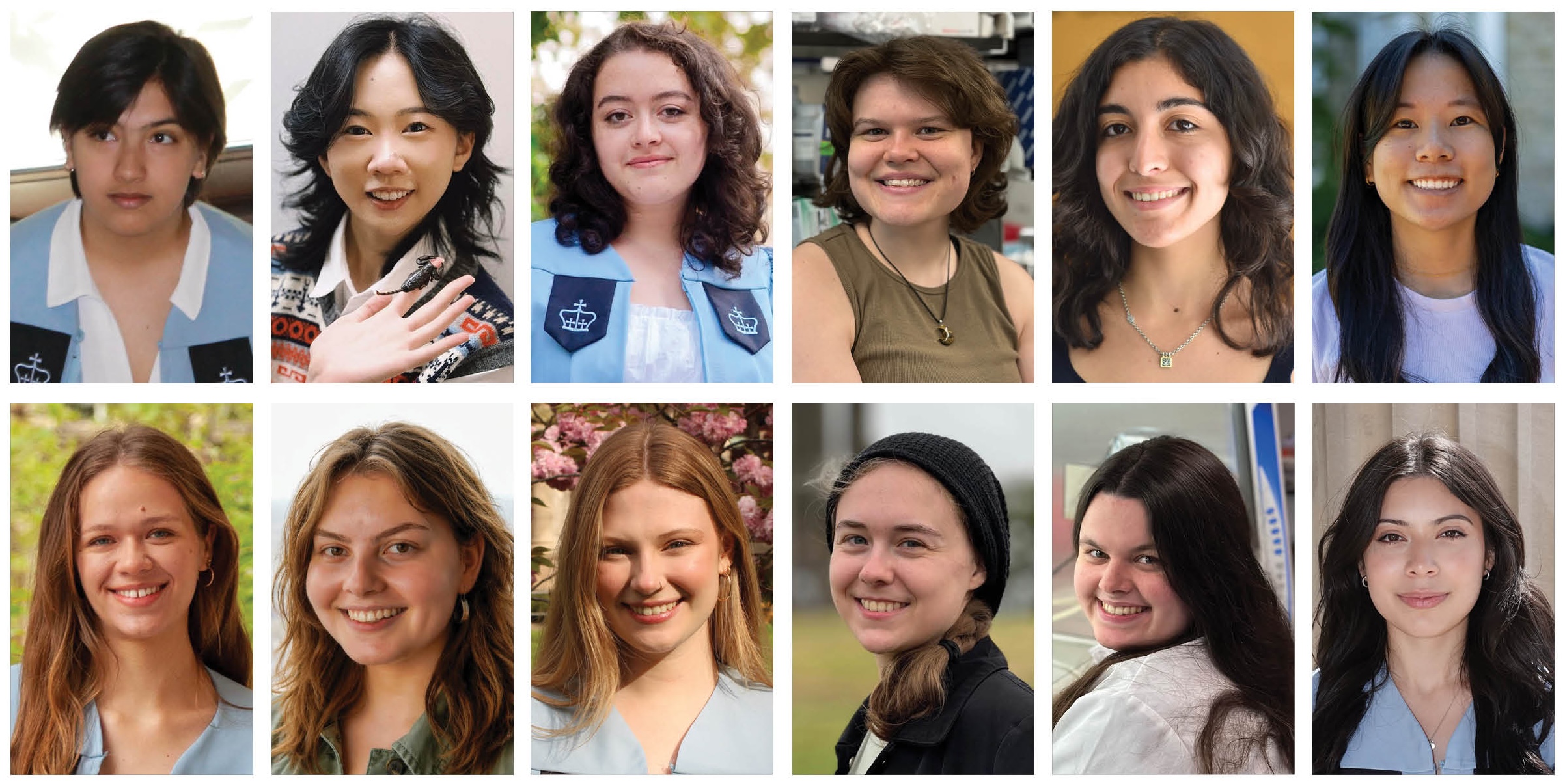
In April, a dozen Barnard College students and alumnae — the highest number on record for the institution — were selected for the U.S. National Science Foundation’s prestigious Graduate Research Fellowship Program, awarded to outstanding individuals pursuing research-based graduate degrees in STEM fields.
“We are tremendously proud of the Barnard students and alumnae who have been recognized by the National Science Foundation for their exceptional promise in STEM fields,” said Barnard Provost and Dean of the Faculty Rebecca L. Walkowitz. “This is a testament both to the strength of our research programs and to our commitment to connecting students with grants and fellowships that match their talents, before and after graduation.”
The Graduate Research Fellowship Program is one of the nation's most prominent and respected fellowships, with just 2,500 selected from a competitive pool of close to 14,000 applicants. Fellows have access to three years of financial support, within a five-year period, as well as international research and professional development opportunities. In 2026, Barnard recipients were associated with a range of specializations, from the traditional lab sciences to artificial intelligence, bioinformatics, and the social sciences.
"This outstanding achievement highlights the unique research environment we cultivate at Barnard,” said Dana Brice Pacheco, who leads fellowships and graduate initiatives at Beyond Barnard. “Through the hands-on experience of our Summer Research Institute, of which many of our recipients of the NSF-GRFP benefited from during their time at the College, as well as the close faculty mentorship fostered in our small classrooms, our students are exceptionally well-prepared to stand out and tackle the rigors of graduate research."
Here are the 2026 awardees of the U.S. National Science Foundation Graduate Research Fellowship:
Analisa Faulkner Valiente ’26 will begin her doctoral studies in pure mathematics at MIT this fall. A mathematical sciences major at Barnard, her research interests lie at the intersection of analysis and topology, with plans to further her studies in gauge theory in graduate school.
Vianny Mondragon ’26 is finalizing her decision on graduate programs. A double major in chemistry and mathematical sciences, she is pursuing a doctorate in engineering, with a focus on lithium-ion battery electrolytes and energy storage materials.
Olivia De Luca ’25 will continue her studies in chemistry as a doctoral student at the University of Pennsylvania. Her research focuses on developing greener catalytic methods for energy generation, with the aim to further sustainable approaches behind critical chemical processes to improve energy efficiency, reduce environmental impact, and enable cleaner technologies for the future.
Kailey Jones ’25 is a doctoral student in the department of Earth, Atmospheric, and Planetary Sciences at Purdue University. Her research centers around tornadoes that form during hurricanes and seeks to advance our ability to understand and forecast these extreme weather events, ultimately reducing threats to life and enhancing preparedness in vulnerable regions.
Alice Wang ’25 is a doctoral student in the comparative biology program at the Richard Gilder Graduate School, American Museum of Natural History. An environmental science major at Barnard, her research investigates the evolution and drivers of intraspecific sound communication in scorpions.
Shahd ElNaggar ’24 will begin her doctoral studies in computational biology at Stanford University in the fall. She plans to use computational and quantitative approaches to understand how communities of bacteria evolve, interact with one another, and contribute to human and environmental health.
Kate Long ’24 will begin the David Rockefeller Graduate Program in Bioscience at the Rockefeller University, with plans to research the mechanistic underpinnings of cancer to uncover new targetable vulnerabilities for the disease.
Claire Looney ’24 will continue her studies in chemistry as a doctoral student at Yale University in the biophysical chemistry subdivision. She is interested in quantitatively describing biological mechanisms by building and utilizing spectroscopic and chemical imaging methods to probe biomolecules.
Grace Tulinsky ’24 is pursuing a combined master of science and doctorate in geography at Pennsylvania State University. Her research focuses on understanding how land-use change and climate variability affect wetland ecosystems, aiming to develop scalable tools to evaluate wetland resilience and better predict how environmental change will impact water systems and human communities.
Emma Harter ’23 is a doctoral student in sociocultural anthropology at Cornell University. Her research examines the political-economic processes that materialize as decay, permeability, and environmental exposure in housing in rural Vermont and New Hampshire, investigating how broader systems of capital and climate are lived, negotiated, and resisted through domestic space.
Chloe Paolucci ’23 is a doctoral student in Columbia University’s Integrated Program in Cellular, Molecular and Biomedical Studies. In Manu Ben-Johny’s lab, she studies calcium signaling with an emphasis on heart physiology and the use of computationally designed de novo peptides.
Avigayil Lev ’22 is a doctoral student in CUNY Graduate Center’s Ecology, Evolutionary Biology, and Behavior Subprogram. A biology major at Barnard, she now works with Monica Mowery to research the ecology and behavior of spiders.
In addition to the 12 Barnard students and alumnae who received Graduate Research Fellowships, nine earned honorable mentions for their academic achievements:
-
Jocelyn Swift ’26, The University of British Columbia
-
Kristi Xing ’26, Memorial Sloan Kettering Cancer Center
-
Vanessa Tzeting Yang ’25, The California Institute of Technology
-
Sanya Gupta ’25, Stanford University
-
Sylvie Oldeman ’25, The University of California, Berkeley
-
Sreoshi Sarkar ’24
-
Nadia Alhassani ’24, The University of Colorado Boulder
-
Talia Benioff-White ’24, The University of California, Santa Barbara
-
Catherine Parkin ’23, Columbia University