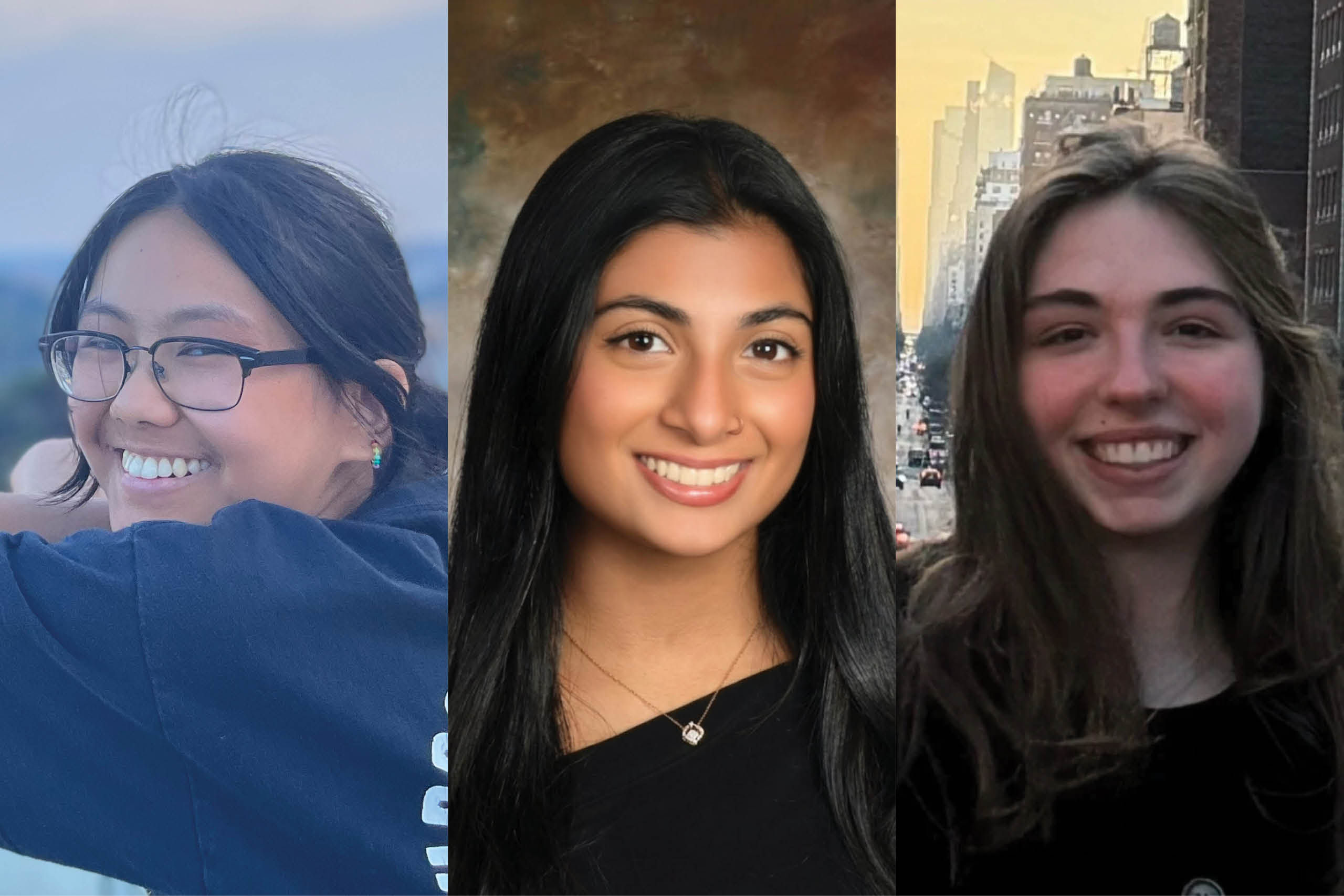
In just a few short weeks, Barnard seniors will cross the stage at Radio City Music Hall for the 134th Commencement, marking the end of their college education. But before that happens, the senior thesis must be submitted — an independent research project that signals expert knowledge on a given subject.
In the third and final edition of our three-part series (read the first here and second here), seniors in the Class of 2026 share what they’re researching, where it’s taken them, and how their final projects got done.
Sophia Ling: Classics and Ancient Studies
Title: Revisiting Illustrations on North African Curse Tablets
What’s your thesis about?
I’m looking at drawings of demons on magical curse tablets from the Roman period that focus on influencing the outcomes of sporting events like chariot races and gladiatorial games. In particular, I’m examining tablets from North Africa, where there is the largest and earliest collection of illustrated curses throughout the Roman Empire.
Is there a finding that surprised you?
Before this project, I was familiar with curse tablets in general, but saw more amatory and theft-related curses. I was surprised to discover the proportion of tablets intended to influence the outcome of sporting events.
Where did the project take you?
Over winter break, I was able to go to Tunisia with the other graduating ancient studies majors and visit several of the sites that produced the objects I'm studying. The mosaics stood out to me, since I have been able to recall ones I saw in person while reading my sources. This has even allowed me to check photos of objects that are not readily available or published online, particularly from smaller museums with limited digitization.
What was your go-to research spot on campus?
The green chairs on the second floor of the Milstein Center definitely saw me a lot, but I spent most of my time on the floor of my dorm, working on top of a small table I built.
Priyanka Nanayakkara: Neuroscience
Title: Testing the Efficacy of Intranasal Macrocyclic Peptides Treatment for Alzheimer’s Disease
What’s your thesis about?
There is no cure for Alzheimer’s, which is an incredibly prevalent disease that causes severe memory impairments, behavioral changes, and eventually death. Existing treatments can be invasive, like Leqembi and Kisunla, which are delivered through an IV. For patients who are cognitively impaired, it’s a hassle to take them to monthly doctors appointments for blood work and MRI scans, transport them to IV centers, and put them on an IV. This project aims to address this unmet need by testing the therapeutic efficacy of a nasal spray that targets Alzheimer’s pathology in a more accessible way for cognitively impaired patients.
Is there a finding that surprised you?
I was surprised to learn that so few people are working on developing non-invasive therapies for Alzheimer’s, particularly given the inaccessibility of current treatments.
Where did the project take you?
I was able to attend the “Grand Rounds” series at Columbia University's Mailman School of Public Health, where two leading researchers in the field argued for and against IV infusion therapies. I was also able to collaborate with another lab at the medical campus in which my data will be used in a collaborative publication. And in 2024 and 2025, I presented my research at Barnard’s Summer Research Institute Poster Session.
What was your go-to research spot on campus?
The Milstein Center's third floor… I love the quiet, cubicle-style set-up where I can still get my fix of natural light!
Madison Boudreau Popovic: Chemistry
Title: Mechanistic Investigations into the Chemistry of Well-Defined Dinuclear Silver(I) Catalysts
What’s your thesis about?
Catalysts are often used in chemistry to efficiently synthesize a desired product, and the catalysts used most often are based on rare and expensive elements. However, my research in Associate Professor of Chemistry Michael Campbell’s “Campbell Group” involves the study of silver-based catalysts, which are lower cost and more abundant.
Is there a finding that surprised you?
One way to obtain a pure product is to recrystallize it — the coolest part of my research involved growing crystals to determine the structure of the molecule.
Where did the project take you?
The American Chemical Society (ACS) hosts an annual conference in the spring where chemists from around the world can present their research. In March, I was able to present a poster alongside a fellow lab member at an ACS conference in Atlanta, Georgia.
What was your go-to research spot on campus?
The lounge area of the Barnard lab spaces, Chandler 2, is where I spent most of my time writing my thesis… and if I wasn’t in Chandler 2, I was on the second floor of the Milstein Center.