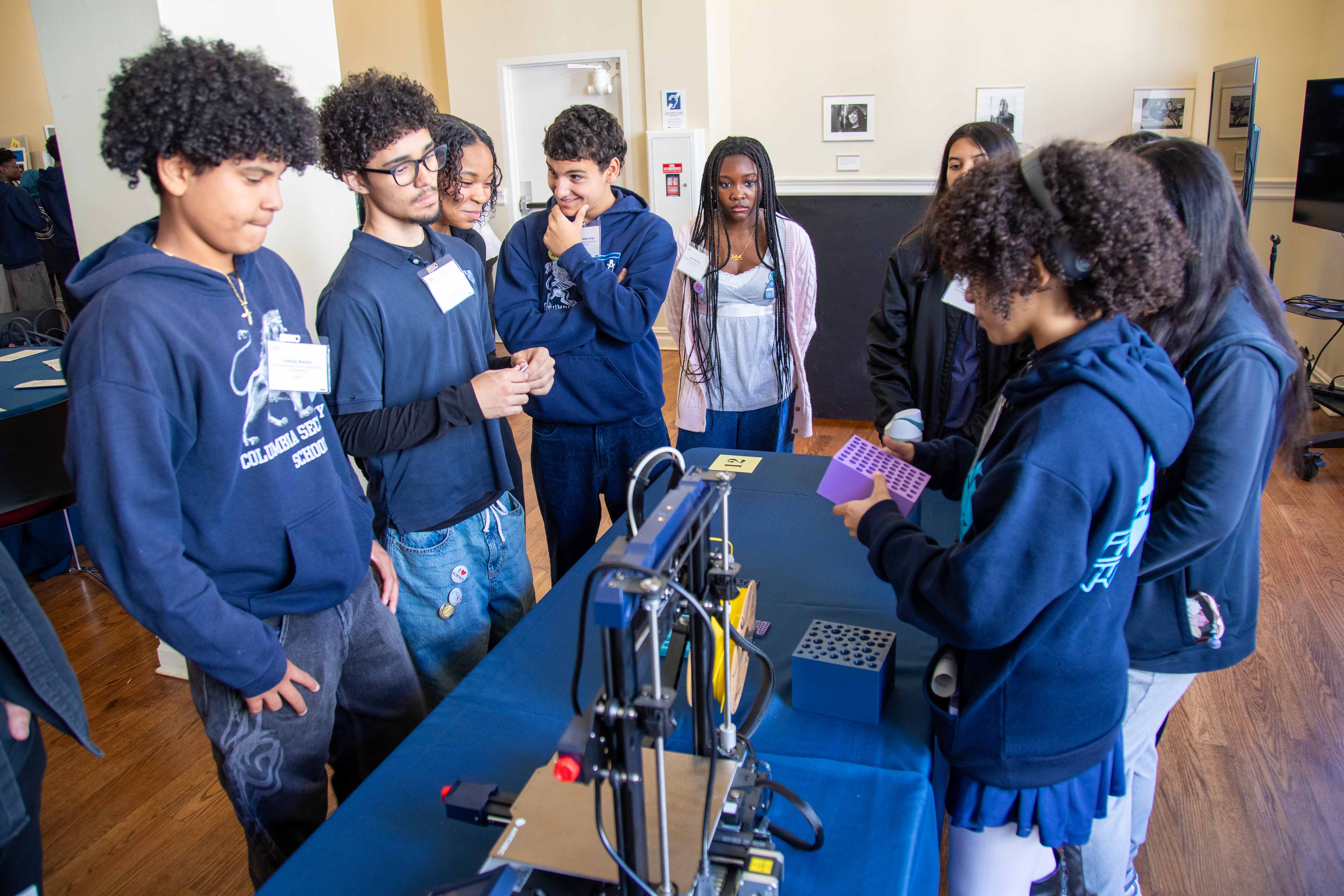
The morning of Friday, April 24, nearly 100 high school students gathered alongside Barnard undergraduates and instructors in the James Room of Barnard Hall for the inaugural STEAM Symposium. A welcome address from Director of Engaged Scholarship, Community Engagement, and Inclusion Mary Rocco set the tone for the event — it would be a day of connection, conversation, and learning, bringing together curious minds from inside and outside Barnard College.
The STEAM Symposium was presented by Barnard’s Office of Community Engagement & Inclusion and the ongoing “STEAM in the City” initiative, which began in 2021 as a professional learning fellowship program for K-8th grade educators working in Upper Manhattan, with support from Barnard and the Stavros Niarchos Foundation. STEAM stands for a range of subjects at the forefront of modern life: Science, Technology, Engineering, Arts, and Mathematics.
High school students from both schools — The Young Women’s Leadership School in Manhattan and Columbia Secondary School in Morningside Heights — had the opportunity to hear about the research projects of current Barnard students, while presenting experiments of their own. After receiving valuable feedback from students and faculty in the physics and computer science departments, the high schoolers visited the Barnard Vision Lab, the Empirical Reasoning Center, the Arthur Ross Greenhouse, and drafting studios in the architecture department for demonstrations of STEAM in action.
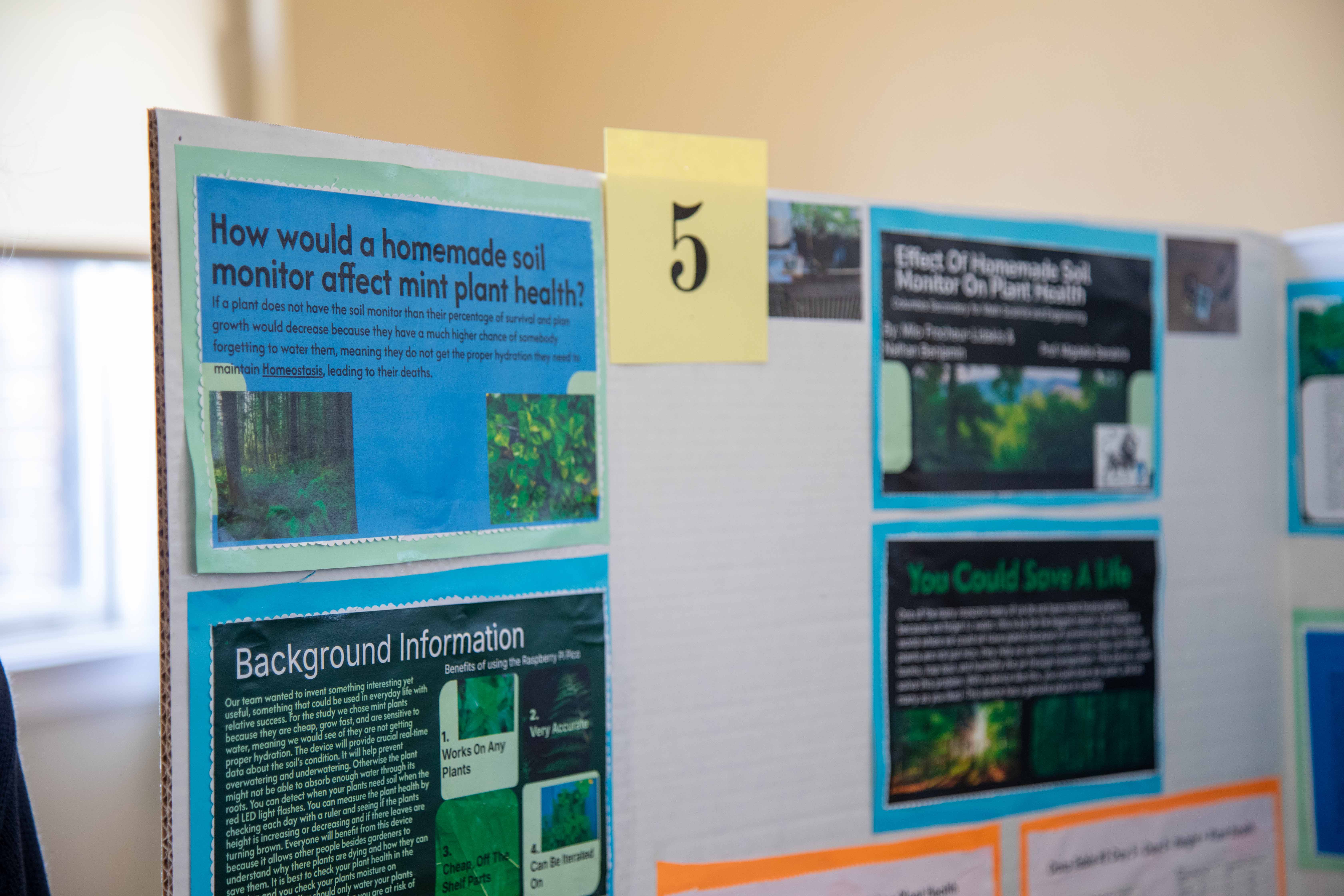
Sofia Gasti, who attends Columbia Secondary School, presented a poster on the impact of artificial intelligence on IQ, explaining her team’s findings that the two showed no correlative connection. “Being here today definitely inspired me to continue on with researching,” said Gasti. “This gave me a step forward into understanding the world of science.”
Other student topics covered the impact of macroplastics in nature, pH levels in fruits and vegetables, and the frog population of the New York Botanical Garden. Later in the afternoon, the high schoolers gained fresh insight on the college admissions process through informative workshops.
Migdalia Sanabria, a science teacher at Columbia Secondary School, has been a Barnard STEAM educator for the last five years. “I’ve seen [the program] grow, and how it can heighten students’ interests in science and possible future careers in STEAM,” she said. “The students worked hard on this research, and now they get to showcase their findings — and that’s also a science skill.”
Zohia Tahir ’29, a Neuroscience & Behavior major and Collegiate Science and Technology Entry Program (CSTEP) Scholar, presented her own findings on the harmful effects of plastic pollutants on Geukensia demissa, a species of mussel, helping provide greater context on the ecological consequences of marine pollution.
Her advice to the visiting high school students?
“Keep progressing in your research,” said Tahir. “And just keep being you.”